Guide · Culture
Sumba's megalithic tombs: where to see them, what they mean
Sumba still drags stone slabs of many tonnes to bury its dead. What the megalithic tombs mean, the villages to visit and how to behave.
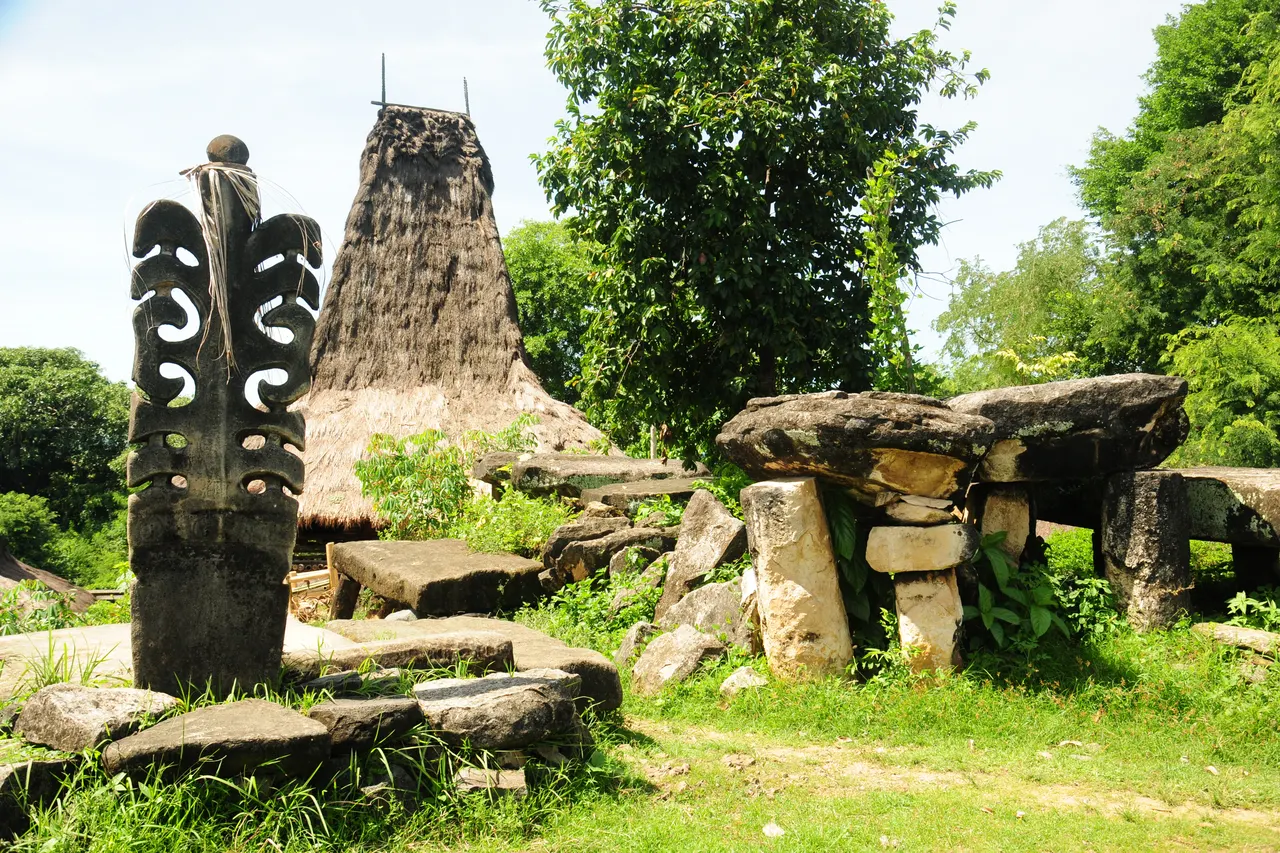
Sumba's megalithic tombs are stone graves, mostly dolmens, built by clans for their dead and tied to Marapu, the island's ancestral belief; archaeologists describe it as one of the few living megalithic traditions, because slabs are still quarried and dragged by hand in a ceremony called tarik batu. The best villages to see them are Ratenggaro and Wainyapu (Southwest Sumba), Tarung and Praijing (West Sumba), Pasunga and Gallubakul (Central Sumba) and Prailiu, Kawangu and Rende (East Sumba). They are not a UNESCO site: as of November 2026 Sumba is not on the World Heritage List or on Indonesia's Tentative List.
- What they are
- Stone graves, mostly dolmens, built by clans; a living tradition
- Belief
- Marapu: ancestors remain present and are buried in the ancestral village
- Stone dragging
- Tarik batu: slabs hauled by hand on a wooden sledge by hundreds of people
- Heaviest tombs cited
- Umbu Sawola, Gallubakul, about 70 tonnes; Umbu Jadar, 79 tonnes (2022)
- Where to see them
- Ratenggaro, Wainyapu, Tarung, Praijing, Pasunga, Gallubakul, Prailiu, Kawangu, Rende
- UNESCO status
- Not on the World Heritage List or Indonesia's Tentative List (Nov 2026)
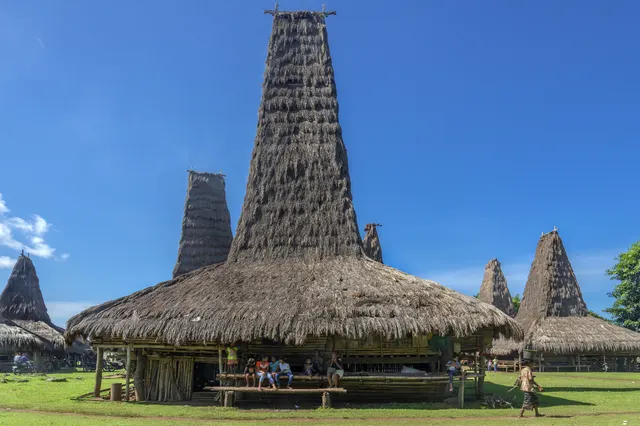
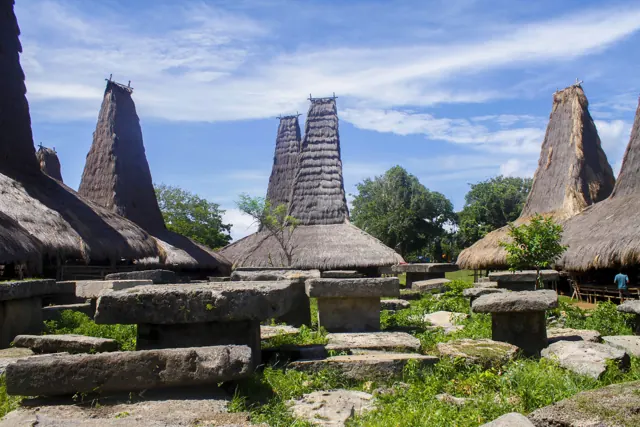
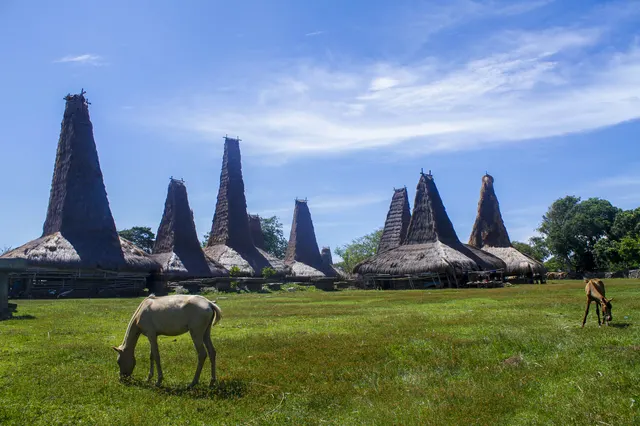
In a Sumbanese village the graveyard is the front yard. Grey slabs as long as a car rest on stone legs between the houses; children do their homework in their shade, dogs sleep against them and washing dries nearby. Some are worn smooth and streaked with lichen. Others are so new that the marks of the tools still show. This is the detail that surprises visitors most: on Sumba, megalithic tombs are not ruins. People are still building them.
The short answer: Sumba's megalithic tombs are stone graves, most of them dolmens (a large capstone over a chamber or on legs), built by clans for their dead and tied to Marapu, the island's ancestral belief. The tradition is alive: stones are still quarried and dragged by hand to the villages. The best places to see them are Ratenggaro and Wainyapu in the south-west, Tarung and Praijing in Waikabubak, Pasunga and Gallubakul in Anakalang, and Prailiu, Kawangu and Rende in the east.
A living megalithic tradition
Archaeologists describe Sumba as one of the few places in Indonesia, and in the world, where megalithic tombs are still made. A 2018 paper in the Indonesian archaeology journal Amerta calls it one of the country's few "living megalithic traditions". The German archaeologist Maria Wunderlich, who documented tombs in ten Sumbanese villages for a 2019 comparative study, notes that all of the island's megalithic monuments are graves, whereas the dolmens of Nias, West Java and South Sumatra served ceremonial purposes.
Sumba's culture in your inbox
Marapu, ikat, horses and ceremonies, explained with care every Sunday.
One email a week. No spam. Unsubscribe in one click. Sumba this weekHow old the tradition is remains uncertain. Wunderlich estimates the oldest standing tombs at about 500 years, and at Pasunga villagers put eleven old royal tombs at 500-600 years; she adds that the age of most graves could not be determined. Indonesian media often give far older figures for megalithic culture on the island. What is documented is that people have been buried on Sumba for much longer: at Lambanapu, near Waingapu, researchers have dated an ancient burial ground to about 2,600 years ago.
The anthropologist Retno Handini, who studied Anakalang, concluded in 2019 that the stone grave is a "key artefact" of Sumbanese identity and that its function has not been replaced, even though cement graves have appeared.
What the megalithic tombs mean
In Marapu belief the ancestors stay present among the living and must be honoured. The dead are buried in the ancestral village, Wunderlich explains, precisely to keep them close to their descendants, and the most important rites take place there. A tomb is therefore less a monument than a house for the dead, standing beside the houses of the living. Our guide to Marapu and traditional villages gives the wider context.
- Rank and wealth. The size of a tomb reflects the means of the family that builds it. Carvings mark status: in Tarung, Wunderlich counted 144 tombs, 76 of them decorated, most often with buffalo heads. In the east, royal tombs carry carved crocodiles, turtles, horses and roosters.
- The body. In the traditional burial described at Pasunga, the dead are wrapped in ikat cloth and placed in a crouched position.
- Before death. A tomb may be built while its owner is alive, after a small offering. Funerals can be delayed for a long time while a family gathers what it needs (see weddings, funerals and ceremonies).
- Christian families too. Many Sumbanese are Christian and still bury their dead in tombs of this form, sometimes with Christian symbols.
Tomb types and their names
Names change from one language area to another. In East Sumba a stone tomb is a reti, and the carved upright stone beside it is a penji. For West Sumba, a list published by the regency government and reported by detikBali in September 2025 distinguishes six forms:
- Watu pawa'i: a long table-like slab on four or more legs, reserved for rulers and nobles.
- Watu kuoba: a single stone hollowed like a coffin, closed with a wide slab and often decorated.
- Koro watu: a box of six slabs set directly on the ground.
- Kuru kata: a variant of the koro watu with two cover slabs.
- Watumanyoba: a plain slab lying flat, traditionally for people of servant rank.
- Kaduwatu: a carved upright stone marking the head and feet of a noble's grave.
Wunderlich's survey recorded 17 types, including closed dolmens in stone, capstones on four or six pillars and, increasingly, tombs of poured cement and tiles.
Tarik batu: how a stone is dragged
The ceremony is known in Indonesian as tarik batu, "pulling the stone". A slab is cut at a quarry, which may belong to the clan or be paid for if it belongs to another, lashed to a wooden sledge and hauled with ropes over log rollers by hundreds of people. A leader stands on the stone and sets the rhythm with chants.
- In April 2004, Al Jazeera watched about 300 men from five villages near Anakalang haul a 35-tonne slab almost 2 km on a sledge of two tree trunks, one carved as a horse's head. By nightfall it had still not reached the grave.
- At Wainyapu in 2008, a slab of about 16 tonnes was pulled about 5 km by roughly 400 men.
- At Pasunga, villagers told Wunderlich that one recent tomb, built of concrete with stones brought from about 20 km away, involved more than 1,000 people in all, about 300 at a time; the transport took about a week, during which some 50 buffaloes and pigs were slaughtered to feed them, and ten more buffaloes when the stones arrived.
- At Gallubakul, the tomb of Umbu Sawola is a single stone of about 70 tonnes; in 2022 a 79-tonne tomb for Umbu Jadar surpassed it.
Building happens mostly after the harvest, from about May to early October. A cement tomb can be finished within a week, a stone one takes weeks or months, and people in Pasunga told the researcher that stone is still considered the better choice. Trucks now move some stones, but the dragging has not disappeared.
Where to see megalithic tombs in Sumba
| Village | Regency | What to see |
|---|---|---|
| Ratenggaro | Southwest Sumba | About 304 stone graves, some lining the shore, below the island's tallest roofs |
| Wainyapu | Southwest Sumba | Between about 1,058 and 1,400 tombs by different counts, a village quarry, new tombs still being added |
| Tarung and Waitabar | West Sumba | A yard of slab tombs between clan houses, a short walk from the centre of Waikabubak |
| Praijing | West Sumba | Terraces of houses around megalithic tombs, 3 km from Waikabubak |
| Praigoli | West Sumba | Watu Kajiwa, a tomb nearly 200 years old, above the Wanokaka Pasola field |
| Pasunga | Central Sumba | An upright slab carved in 1926 with a chief and his wife, beside the main road |
| Gallubakul | Central Sumba | The tomb of Umbu Sawola, a single stone of about 70 tonnes |
| Prailiu | East Sumba | The tomb of the last king, Umbu Djaka (died 2008), reported at around 40 tons, inside Waingapu |
| Kawangu | East Sumba | 39 reti recorded in a 2016 study, several with decorated penji |
| Rende | East Sumba | Royal tombs topped with carved animals, about 70 km from Waingapu |
If you are crossing the island by road, Pasunga and Gallubakul need no detour. Wunga, on the north coast of East Sumba, keeps very old graves but is not set up for visitors: go only with a local guide.
Are Sumba's megalithic tombs a UNESCO site?
No. As of November 2026, nothing on Sumba is inscribed on the UNESCO World Heritage List, and the island does not appear on Indonesia's Tentative List, which has 21 entries. That list does include other megalithic and traditional sites: the megalithic heritage of the Lore Lindu area in Sulawesi (added in 2025), the Tana Toraja traditional settlement and the Bawomataluo site on Nias (both 2009). Websites that describe a Sumbanese village as a "UNESCO site" are mistaken.
How to visit the tombs respectfully
- They are family graves. Never sit, stand or climb on a tomb, and do not put bags or cameras on one, even if you see villagers resting on them.
- Do not touch carvings, offerings, buffalo horns or ritual objects.
- Ask first. Greet whoever is there, ask before entering the tomb area and before photographing people. Ask before flying a drone.
- Sign the guest book and leave a donation, usually around IDR 20,000-50,000 per person, in small notes.
- Dress modestly and go with a local guide or driver who can translate: the family's own account of a tomb is the best part of the visit.
- If a funeral or stone dragging is under way, stay back and let your guide ask whether visitors are welcome. It is the family's decision.
The tombs can be visited all year; the dry season, roughly May to September, makes the roads easier and is also when most building takes place. For more on the island's past, see our short history of Sumba.
Frequently asked questions
Why does Sumba have megalithic tombs?
Because in Marapu, the island's ancestral belief, the dead remain part of the clan and are buried in the ancestral village, close to their descendants. A stone tomb is the house of the dead and shows the rank and means of the family.
Are megalithic tombs still built in Sumba?
Yes. Researchers describe Sumba as one of the few living megalithic traditions. Stone tombs are still made, mostly after the harvest between about May and early October, alongside a growing number of cement ones.
What is tarik batu?
Tarik batu means pulling the stone: a quarried slab is tied to a wooden sledge and hauled with ropes over log rollers by hundreds of people, with feasts for the helpers. A 35-tonne slab was pulled by about 300 men near Anakalang in 2004.
Where are the best megalithic tombs in Sumba?
For the largest and most carved, go to Pasunga and Gallubakul in Anakalang, Central Sumba. For tombs in a village setting, visit Ratenggaro, Wainyapu, Tarung or Praijing in the west, and Prailiu, Kawangu or Rende in the east.
How old are Sumba's megalithic tombs?
It is uncertain. The archaeologist Maria Wunderlich estimates the oldest standing tombs at about 500 years, and most cannot be dated. An older burial ground at Lambanapu has been dated to about 2,600 years ago.
Can tourists touch or sit on the tombs?
No. They are family graves. Do not sit, stand or climb on them, do not touch carvings or offerings, ask before taking photos and leave a donation in the guest book.
Places in this guide
- Ratenggaro village · Southwest Sumba · Open in maps
- Wainyapu village · Southwest Sumba · Open in maps
- Tarung village · Waikabubak, West Sumba · Open in maps
- Praijing village · Waikabubak, West Sumba · Open in maps
- Kampung Pasunga · Anakalang, Central Sumba · Open in maps
- Gallubakul · Anakalang, Central Sumba · Open in maps
- Kampung Raja Prailiu · East Sumba · Open in maps
- Kawangu (kelurahan centre) · Pandawai, East Sumba · Open in maps
- Praiyawang, Rende · East Sumba · Open in maps
- Maria Wunderlich, Megalithic Monuments and Social Structures: comparative studies on recent and Funnel Beaker societies (chapter 5.1, Sumba), Sidestone Press, 2019
- Retno Handini, Kubur batu sebagai identitas diri masyarakat Sumba: bukti keberlanjutan budaya megalitik di Anakalang, Sumba Tengah, Amerta 37(1), 2019
- Wibowo, Handini, Simanjuntak et al., Geological approach to the raw material of megalithic tombs in East Sumba, Amerta 36(2), 2018
- Indonesia: Megalithic arts struggle on, Al Jazeera, 27 Apr 2004
- Mengenal batu kubur tradisi masyarakat Sumba: sejarah dan fungsinya, detikBali, 15 Sep 2025
- Indonesia: properties on the World Heritage List and the Tentative List, UNESCO World Heritage Centre, accessed 14 Nov 2026
Spotted an error? Write to info@ecobeachcity.com.
Sumba's culture in your inbox
Marapu, ikat, horses and ceremonies, explained with care every Sunday.
One email a week. No spam. Unsubscribe in one click. Sumba this week