Travel
Praijing village, Sumba: how to visit and what to know
Terraces of towering thatched roofs on a hill above Waikabubak, a living Marapu village that now runs its own tourism.
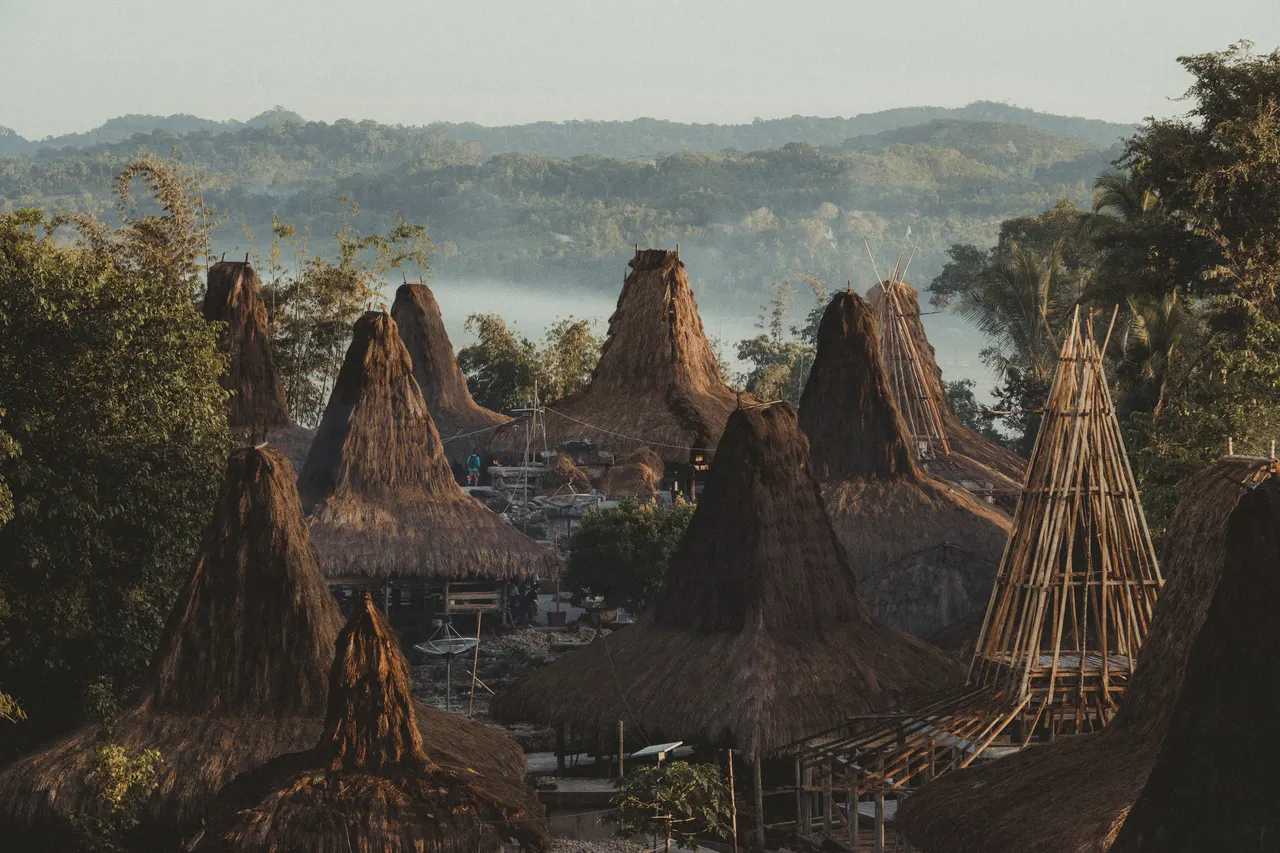
Praijing (also written Prai Ijing) is a traditional village in Desa Tebara, about 3 km from the centre of Waikabubak in West Sumba, known for its terraces of tall-roofed houses around megalithic stone tombs. It is about 45 km, roughly 1 hour by car, from Tambolaka airport; visitors pay a small village levy or contribution, and the village itself offers guided tours, weaving workshops and homestays.
- Where
- Desa Tebara, about 3 km from central Waikabubak, West Sumba
- From the nearest airport
- Tambolaka (TMC): about 45 km, roughly 1 hour by car
- Best time
- Dry season (about May-September), early morning
- Entry
- Village levy or contribution; guided tours around IDR 250,000-430,000 (2026)
- Good for
- Architecture, Marapu culture, ikat weaving, homestays
Early morning on the hill at Praijing. Mist still hangs in the valley below Waikabubak, wood smoke drifts out from under the eaves, and the first light catches the tips of the roofs, tall grass towers that rise far above the houses like raised hands. Chickens scratch between the stone tombs in the central yard, a woman sets up her loom on a veranda, and somewhere a pig complains under a house. This is a home before it is a sight, and it is one of the most beautiful villages on the island.
Praijing, also spelled Prai Ijing, belongs to Desa Tebara in the Kota Waikabubak district of West Sumba. Its houses climb a hillside in terraces around megalithic tombs and stone platforms, and it is close enough to town to visit in an hour or two.
What Praijing is and why go
Praijing is a kampung adat, a customary village where clans keep their ancestral houses and many families still follow Marapu, the ancestral belief of Sumba. Local writing on the village says fewer than 50 traditional houses remain, the ones that survived a fire in 2000. Each house stands on stilts with three levels: the space under the floor for pigs and poultry, the living floor for the family, and the high tower under the roof where heirlooms and food are kept. Carved pillars mark a men's side and a women's side, and residents believe ancestral spirits dwell in the round details on the main posts.
Low Tide, every Sunday
One short letter a week about living well, from an island with more horses than traffic lights. Free.
We only use your email to send the letter. Unsubscribe in one click.What makes Praijing special today is that the village runs its own tourism. A village-owned enterprise (BUMDes) began managing visits in July 2018, and in 2026 Praijing (listed as Desa Wisata Kampung Prai Ijing) received an ASEAN Sustainable Tourism Award. Recent reporting describes heritage tours of up to three hours, full-day tours, weaving workshops where you watch the whole process from thread to cloth, and homestays with meals. Your money here goes, at least in part, to the community that lives in the houses.
For background on Marapu, house design and village etiquette, read our guide to Marapu, ikat and traditional villages.
How to get to Praijing
- From Tambolaka airport (TMC): about 45 km by road, roughly 1 hour by car via Waikabubak.
- From Waikabubak: about 3 km from the centre, 10-20 minutes by car or motorbike taxi (ojek). Some travellers walk out from town through the hamlets south of the Waingapu road.
- From Waingapu (WGP): about 135 km, realistically 3.5-4.5 hours by car, so it makes sense as part of a cross-island trip rather than a day trip.
The last stretch climbs to the top of the hill. There is no regular public transport to the gate, so most visitors come with a driver or an ojek from Waikabubak.
When to go and the best time of day
The dry season, roughly May to September, brings the most reliable roads and clear skies. Morning is the loveliest time: soft light on the roofs, cooler air in the highlands around Waikabubak, and daily life in full swing. Late afternoon is also good for photographs. Around November the communities of the Waikabubak area observe Wulla Poddu, a sacred period of rituals; during ritual times some activities and areas may be closed to outsiders, so ask your guide before you go.
Tips and etiquette
- Fees: expect a village levy (retribusi) or a contribution recorded in a guest book. Guided packages reported in 2026 were around IDR 250,000 per person for a heritage tour of up to three hours and around IDR 430,000 for a full day including the levy (roughly EUR 13-23 or USD 15-26). Homestays were reported at around IDR 300,000 per person per night with three meals. Prices vary and change, so check on arrival.
- Ask before every photo, of people and of houses. Do not climb on tombs or touch ritual objects, altars or the posts of sacred houses.
- Dress modestly: shoulders and knees covered. A sarong works well.
- Children asking for sweets or money: it is kinder to give to the parents, the guest book or the village enterprise, or to buy weaving directly from the women who made it.
- A small gift of betel nut (sirih pinang) is a traditional gesture of respect when you are welcomed into a house.
- Bring cash in small notes; there are ATMs in Waikabubak.
Nearby
- Tarung village, the ritual centre on a hill in the middle of Waikabubak, 10-15 minutes away.
- Waikabubak town, with its morning market and simple places to eat.
- Lapopu waterfall, about 16 km south, the tiered waterfall inside the national park.
- Waikelo Sawah waterfall, on the road to Tambolaka, good for a swim stop.
Planning your days on the island? See how to get to Sumba from Bali and where to stay in Sumba.
Frequently asked questions
How far is Praijing from Waikabubak?
About 3 km from the town centre, 10-20 minutes by car or ojek. From Tambolaka airport it is about 45 km, roughly 1 hour.
Is there an entrance fee for Praijing village?
Visitors pay a village levy or a contribution in the guest book. Village-run guided tours reported in 2026 cost around IDR 250,000 for up to three hours and around IDR 430,000 for a full day. Prices vary.
Can you stay overnight in Praijing?
Yes. The village offers homestays, reported at around IDR 300,000 per person per night with three meals in 2026.
Can I take photos in Praijing?
Usually yes, but always ask first, both for people and for houses, and never climb on the stone tombs.
Places in this guide
- Praijing village · Waikabubak, West Sumba · Open in maps
- Filosofi tiang rumah adat Praijing di Sumba Barat, Good News From Indonesia, 9 October 2020
- Mengenal Kampung Adat Prai Ijing Sumba, menjaga tradisi menggerakkan ekonomi, Katadata, 5 September 2026
- Desa Wisata Kampung Prai Ijing kantongi ASEAN Sustainable Tourism Awards 2026, SWA, 2 February 2026
- Kisah Desa Tebara di Sumba Barat jadi ikon wisata kelas dunia, Merdeka.com, 14 June 2021
- Travel Sumba: Waikabubak, Praijing, Tarung, The Spice Route End
- Waikabubak, Sumba: what to see, where to stay and travel tips, Backindo, 2025
- Coordinates: Kampung Praiijing, OpenStreetMap (Nominatim, node 1666801971)
Spotted an error? Write to info@ecobeachcity.com.
Low Tide, every Sunday
One short letter a week about living well, from an island with more horses than traffic lights. Free.
We only use your email to send the letter. Unsubscribe in one click.