Travel
Useful words in Sumba: Indonesian and local phrases for travellers
Outside the resorts, English runs out fast. These Indonesian essentials, plus a few verified words in Kambera and Weyewa, will carry you through markets, roads and villages.
Indonesian (Bahasa Indonesia) is understood almost everywhere in Sumba and is the language to learn: start with terima kasih (thank you), permisi (excuse me), berapa harganya? (how much is it?) and the numbers. At home people speak one of about nine local languages, such as Kambera in the east and Weyewa or Kodi in the west, and English is mostly limited to towns and tourism. A few local words, like the Kambera numbers or the titles Umbu and Rambu, earn instant smiles.
- Official language
- Indonesian (Bahasa Indonesia), understood almost everywhere
- Local languages
- About nine, including Kambera (east), Weyewa and Kodi (west)
- Largest local language
- Kambera, about 240,000 speakers
- English
- Mostly in towns, hotels and with guides
- Most useful phrase
- Terima kasih (thank you); permisi (excuse me) in villages
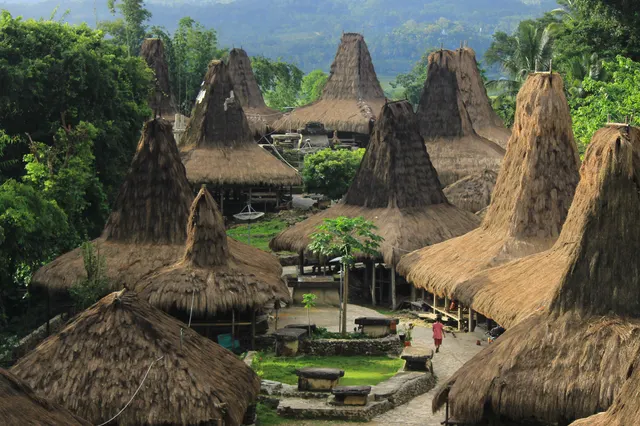
The driver turns off the asphalt, the road narrows to a track between maize fields, and suddenly you are in a village of high thatched roofs. Children run up shouting a cheerful "Halo!", an old man in an ikat cloth nods from the shade of a veranda, and someone asks you something you do not understand. This is the moment a few words of Indonesian change everything: a greeting, a thank you, a question about the way. On Sumba, where English is rare once you leave the towns, they turn you from a spectator into a guest.
This page gives you the Indonesian you will actually use on the island, with simple pronunciation hints, and a handful of words in Sumba's own languages that we could verify in linguistic sources.
Which languages are spoken in Sumba?
Indonesian is the national language, used in schools, offices, churches and with outsiders, and almost everyone under middle age speaks it well. At home, though, Sumbanese speak their regional language. The island has about nine Austronesian languages:
Low Tide, every Sunday
One short letter a week about living well, from an island with more horses than traffic lights. Free.
We only use your email to send the letter. Unsubscribe in one click.- Kambera (East Sumbanese): about 240,000 speakers across the eastern half of the island, with many local dialects. Its name comes from a traditional domain near Waingapu.
- Weyewa (Wejewa, Wewewa): about 65,000 speakers in Southwest Sumba, with dialects such as Lauli (Loli) and Tana Righu.
- Kodi: about 20,000 speakers at the western tip, classed as endangered.
- Smaller languages such as Anakalang, Wanukaka, Lamboya and Mamboru; Wanukaka and Lamboya each have fewer than about 20,000 speakers.
The languages of the west are very different from each other, while the east shares one language with many dialects. English is helpful in towns and with guides, but in the centre of the island and in rural villages you will struggle without some Indonesian. If someone knows a little English, though, they will usually be keen to try it with you.
How to pronounce Indonesian
Indonesian is written in the Latin alphabet and is pronounced much as it is spelled. A few rules cover most words:
- c sounds like "ch" in check: cukup is "CHOO-kup".
- r is rolled, as in Spanish.
- ng is as in "sing", with no hard g; ngg is as in "finger".
- ny is like the Spanish ñ, as in "canyon".
- A k at the end of a word is a soft catch in the throat, like the break in "uh-oh": tidak is "TEE-dah'".
- e is often a short "uh", as in terima ("tuh-REE-mah").
Greetings and courtesy
| Phrase | Meaning | Pronunciation hint |
|---|---|---|
| Halo | Hello | HAH-loh |
| Selamat pagi | Good morning (until about 11:00) | suh-LAH-maht PAH-gee |
| Selamat siang | Good day (about 11:00-15:00) | suh-LAH-maht SEE-ahng |
| Selamat sore | Good afternoon (about 15:00 to dusk) | suh-LAH-maht SO-ray |
| Selamat malam | Good evening | suh-LAH-maht MAH-lahm |
| Apa kabar? | How are you? | AH-pah KAH-bar |
| Baik, terima kasih | Fine, thank you | bah-EE', tuh-REE-mah KAH-see |
| Terima kasih (banyak) | Thank you (very much) | tuh-REE-mah KAH-see (BAH-nyak) |
| Sama-sama | You're welcome | SAH-mah SAH-mah |
| Permisi | Excuse me (to pass, or to announce yourself) | puhr-MEE-see |
| Maaf | Sorry | mah-AHF |
| Ya / Tidak | Yes / No | yah / TEE-dah' |
| Nama saya ... | My name is ... | NAH-mah SAH-yah |
| Saya tidak mengerti | I don't understand | SAH-yah TEE-dah' muh-NGUHR-tee |
| Tolong bicara lebih pelan | Please speak more slowly | TOH-long bee-CHAH-rah LUH-bee PUH-lahn |
| Selamat jalan / Sampai jumpa | Goodbye (to someone leaving) / See you | suh-LAH-maht JAH-lahn / SAHM-pai JOOM-pah |
Addressing people: call a man of your age or older Bapak or Pak, and a woman Ibu or Bu. Kakak (older sibling) is a friendly word for someone slightly older, and Adik for a child or younger person. These polite forms matter in Sumba, where age and rank shape how people speak to each other.
Numbers, money and prices
| Number | Indonesian | Pronunciation hint |
|---|---|---|
| 1 / 2 / 3 | satu / dua / tiga | SAH-too / DOO-ah / TEE-gah |
| 4 / 5 / 6 | empat / lima / enam | UHM-paht / LEE-mah / UH-nahm |
| 7 / 8 / 9 | tujuh / delapan / sembilan | TOO-jooh / duh-LAH-pahn / suhm-BEE-lahn |
| 10 / 20 / 50 | sepuluh / dua puluh / lima puluh | suh-POO-looh / DOO-ah POO-looh / LEE-mah POO-looh |
| 100 | seratus | suh-RAH-toos |
| 1,000 | seribu | suh-REE-boo |
| 10,000 / 50,000 | sepuluh ribu / lima puluh ribu | suh-POO-looh REE-boo / LEE-mah POO-looh REE-boo |
| 100,000 | seratus ribu | suh-RAH-toos REE-boo |
| 1,000,000 | satu juta | SAH-too JOO-tah |
Prices are almost always quoted in thousands, and people often drop the zeros: "lima puluh" at a market stall usually means IDR 50,000. Village donations, parking and entry fees are paid in small notes, so practise sepuluh ribu and dua puluh ribu.
| Phrase | Meaning | Pronunciation hint |
|---|---|---|
| Berapa harganya? | How much is it? | buh-RAH-pah HAR-gah-nyah |
| Terlalu mahal | Too expensive | tuhr-LAH-loo MAH-hahl |
| Kalau ... bagaimana? | How about ... ? (to offer a price) | KAH-low ... BAH-gai-MAH-nah |
| Murah / mahal | Cheap / expensive | MOO-rah / MAH-hahl |
| Di mana ada ATM? | Where is an ATM? | dee MAH-nah AH-dah AH-teh-ehm |
| Minta bon | The bill, please | MIN-tah bon |
Directions and on the road
| Phrase | Meaning | Pronunciation hint |
|---|---|---|
| Di mana ...? | Where is ...? | dee MAH-nah |
| Bagaimana saya pergi ke ...? | How do I get to ...? | BAH-gai-MAH-nah SAH-yah puhr-GEE kuh |
| Kiri / kanan / lurus | Left / right / straight on | KEE-ree / KAH-nahn / LOO-roos |
| Belok kiri / belok kanan | Turn left / turn right | BEH-lo' KEE-ree / BEH-lo' KAH-nahn |
| Berhenti di sini | Stop here | buhr-HUHN-tee dee SEE-nee |
| Tunggu di sini | Wait here | TOONG-goo dee SEE-nee |
| Dekat | Near | DUH-kaht |
| Pom bensin / bensin | Petrol station / petrol | pom BEN-seen |
| Utara / selatan / timur / barat | North / south / east / west | oo-TAH-rah / suh-LAH-tahn / TEE-moor / BAH-raht |
Useful place words: pantai (beach), air terjun (waterfall), bukit (hill), kampung adat (traditional village), pasar (market) and bandara (airport). The regency names you will see on signs are Sumba Barat (West), Sumba Barat Daya (Southwest), Sumba Tengah (Central) and Sumba Timur (East). For transport tips, see getting around Sumba.
Food and drink
| Phrase | Meaning | Pronunciation hint |
|---|---|---|
| Saya mau pesan ... | I would like to order ... | SAH-yah MAH-oo puh-SAHN |
| Nasi / ikan / ayam | Rice / fish / chicken | NAH-see / EE-kahn / AH-yahm |
| Air putih | Drinking water | AH-eer POO-tee |
| Kopi / teh | Coffee / tea | KOH-pee / teh |
| Kopi pahit / tanpa gula | Coffee without sugar | KOH-pee PAH-hit / TAHN-pah GOO-lah |
| Pedas | Spicy | puh-DAHS |
| Saya vegetarian | I am vegetarian | SAH-yah veh-geh-TAH-ree-ahn |
| Saya tidak makan babi | I don't eat pork | SAH-yah TEE-dah' MAH-kahn BAH-bee |
| Enak! | Delicious! | EH-nah' |
Coffee is grown on Sumba and usually served strong and very sweet, so ask for kopi pahit if you want it plain. For what to try, see our guide to Sumbanese food.
In a traditional village
These short sentences are the most valuable on this page. Use them with the guest book, the small donation and the modest clothes described in Marapu, ikat and traditional villages.
| Phrase | Meaning | Pronunciation hint |
|---|---|---|
| Permisi, boleh masuk? | Excuse me, may I come in? | puhr-MEE-see, BOH-leh MAH-sook |
| Bolehkah saya lihat? | May I have a look? | BOH-leh-kah SAH-yah LEE-haht |
| Boleh foto? | May I take a photo? | BOH-leh FOH-toh |
| Ini apa? | What is this? | EE-nee AH-pah |
| Terima kasih banyak, Bapak / Ibu | Thank you very much, sir / madam | tuh-REE-mah KAH-see BAH-nyak |
If the answer to a photo request is tidak or a shake of the head, put the camera away. Graves and ritual objects are off limits whatever the answer.
Health and emergencies
| Phrase | Meaning | Pronunciation hint |
|---|---|---|
| Tolong! | Help! | TOH-long |
| Saya sakit | I am ill | SAH-yah SAH-kit |
| Saya perlu dokter | I need a doctor | SAH-yah PUHR-loo DOK-tuhr |
| Rumah sakit / apotek | Hospital / pharmacy | ROO-mah SAH-kit / AH-poh-tek |
| Saya tersesat | I am lost | SAH-yah tuhr-SUH-saht |
More in our safety and health guide.
A few words in Sumba's own languages
Local languages on Sumba are passed on mostly by speaking, and spellings vary. We include only words we could check in linguistic sources, so treat this as a friendly start, not a course. Ask your guide how they say it in their village; people are usually delighted.
Kambera (East Sumba)
The numbers below come from the linguist Marian Klamer, who wrote the standard grammar of Kambera. The letter ɗ is an "implosive" d, made by pulling the sound slightly inwards; an ordinary d is close enough to be understood.
| Kambera | Meaning | Pronunciation hint |
|---|---|---|
| ɗiha | one | DEE-hah |
| ɗua | two | DOO-ah |
| tailu | three | TAI-loo |
| patu | four | PAH-too |
| lima | five | LEE-mah |
| nomu | six | NOH-moo |
| pitu | seven | PEE-too |
| walu | eight | WAH-loo |
| hiwa | nine | HEE-wah |
| hakambulu | ten | hah-kahm-BOO-loo |
| nda / ndia | not / no | n-DAH / n-DEE-ah |
Two curiosities: speakers say tailu rather than the older tilu for "three", because tilu also means "egg". And around 1900 Kambera changed every old "s" into "h", which is why the island is Humba in the local languages and the Kambera language is also called Hilu Humba.
Words shared across the island
| Word | Meaning | Pronunciation hint |
|---|---|---|
| wai / wee | water | WAI / WEH |
| Umbu | man; a respectful title before a man's name | OOM-boo |
| Rambu | woman; a respectful title before a woman's name | RAHM-boo |
You will see wai and wee in place names everywhere: Waingapu, Waikabubak, Weekuri, Waikelo. Umbu and Rambu are traditionally associated with noble families in East Sumba, so use them only as you hear locals use them.
Weyewa (Southwest Sumba)
We did not find a reliable published list of Weyewa greetings, so we do not invent one. A 2025 study of Weyewa kinship terms records ama (father) and inna (mother), words you will hear constantly in family life, and notes that terms of address follow age, which shapes respect and politeness. For Kodi, we found no reliable source for everyday phrases; stick to Indonesian there.
Tips for using your words
- Smile and try: even a badly pronounced terima kasih is warmly received.
- Write numbers down: when bargaining for ikat or arranging a driver, writing the figure avoids misunderstandings about thousands.
- Use a guide in villages: they can translate into the local language and explain customs. See where to stay in Sumba for bases near the villages.
- Download an offline translator: mobile signal disappears in the hills, so download Indonesian for offline use before leaving town.
Planning the trip itself? Start with how to get to Sumba from Bali and our regency guides to East, West, Southwest and Central Sumba.
Frequently asked questions
What language do they speak in Sumba?
Indonesian is the common language, understood almost everywhere. At home people speak local languages such as Kambera in the east and Weyewa, Kodi, Wanukaka or Lamboya in the west.
Do people speak English in Sumba?
Only a little, mostly in towns, hotels and among guides. In villages and the interior you will need some Indonesian or a local guide.
How do you say thank you in Sumba?
In Indonesian, terima kasih (tuh-REE-mah KAH-see), which is understood everywhere on the island. Local languages have their own words, but Indonesian is always appropriate.
Is Sumbanese the same as Indonesian?
No. There is no single Sumbanese language: the island has about nine local languages, very different from Indonesian and, in the west, from each other.
What should I say when I enter a traditional village?
Say permisi (excuse me), greet people with selamat pagi or selamat siang, ask boleh foto? before any photo, sign the guest book and say terima kasih banyak when you leave.
- Indonesian phrasebook, Wikivoyage, accessed Nov 2026
- Kambera language, Wikipedia (speakers, s to h sound change, negators)
- Numeral systems: Kambera (data from Marian Klamer, 1997), Eugene Chan, Max Planck Institute for Evolutionary Anthropology
- Country and People (languages; wai, umbu, rambu), Sumba Information (Matthias Jungk), accessed Nov 2026
- Kajian linguistik antropologi terhadap istilah kekerabatan dalam bahasa Wewewa Sumba Barat Daya, K. Kami and M. Bili, Indo-MathEdu Intellectuals Journal 6(1), 2025
- Wejewa (Weyewa) language, Omniglot, accessed Nov 2026
- Kodi language, Wikipedia
- Sumba, Wikipedia (languages, native name Humba)
Spotted an error? Write to info@ecobeachcity.com.
Low Tide, every Sunday
One short letter a week about living well, from an island with more horses than traffic lights. Free.
We only use your email to send the letter. Unsubscribe in one click.