Guide · Culture
A short history of Sumba: sandalwood, horses, slaves and the Dutch
From megalithic clans and Majapahit to the sandalwood and horse trades, the slave raids, Dutch rule from 1906 and today's four regencies: a timeline.
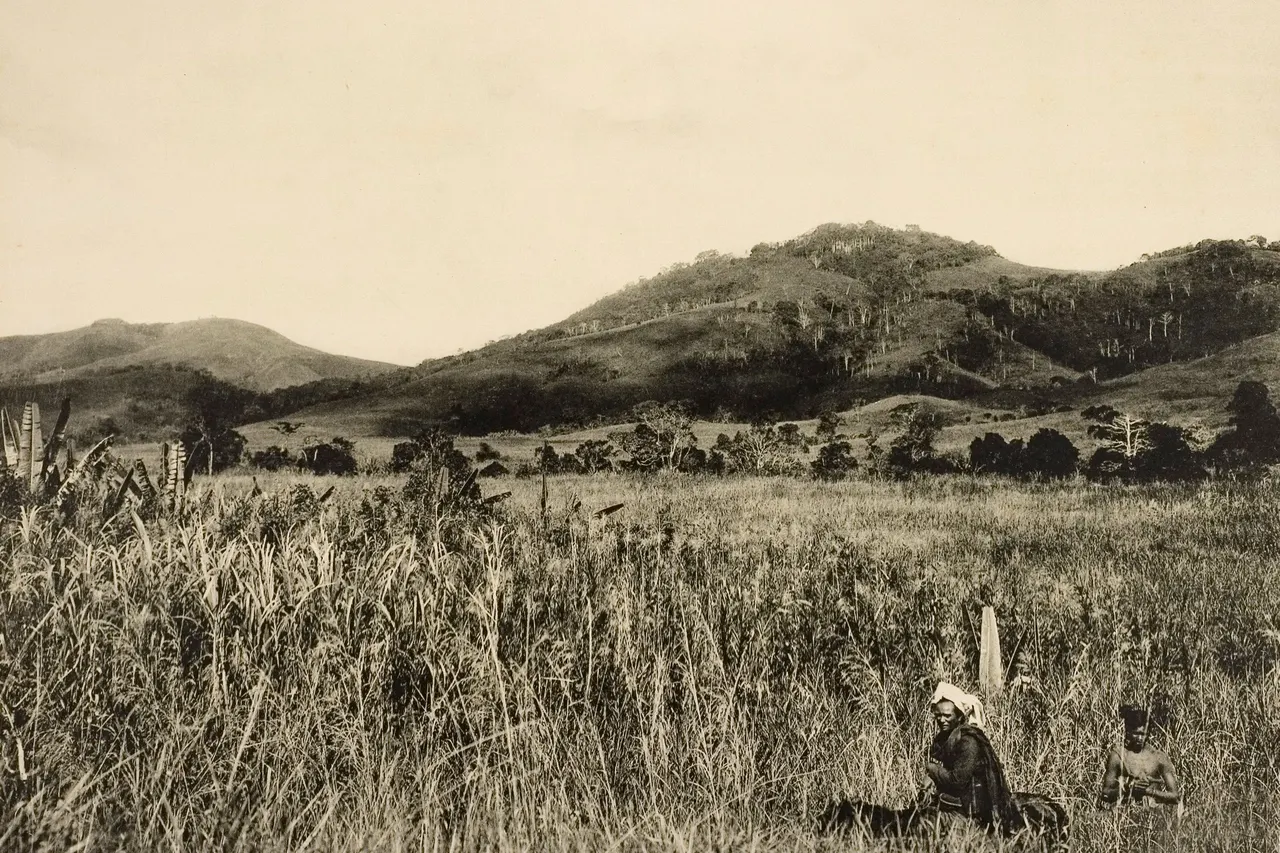
Sumba was home to clan-based chiefdoms with a megalithic burial tradition long before written records, and from at least the 14th century it was tied to regional trade through sandalwood and horses, appearing in Javanese sources as a Majapahit vassal. Between the 17th and 19th centuries it fell under the loose influence of Bima and Makassar and was a major source of slaves, while traders from Ende dominated its commerce. The Dutch signed a first contract in 1756 but took full control only from 1906; Sumba then joined independent Indonesia and has had four regencies since 2007.
- Old name
- Sandalwood Island (Dutch: Sandelbosch Eyland)
- Earliest written mention
- 14th century, Nagarakretagama (vassal of Majapahit)
- First Dutch contract
- 1756, with a coalition of Sumbanese chiefs
- Horse trade
- First 98 horses shipped in 1841; over 4,000 by 1846
- Full colonial control
- From 1906 (military pacification)
- Four regencies
- Since 2 January 2007; about 852,832 people (mid-2025)
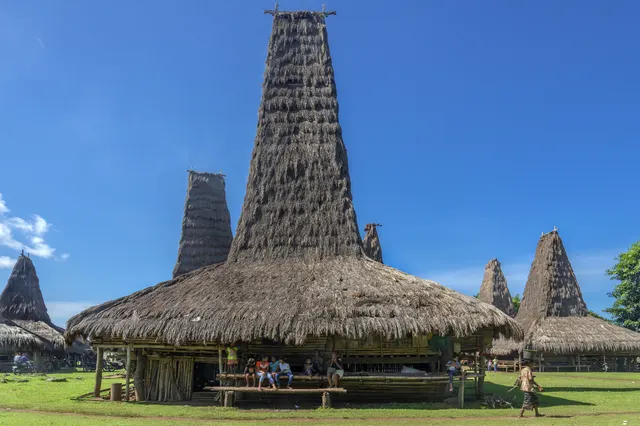
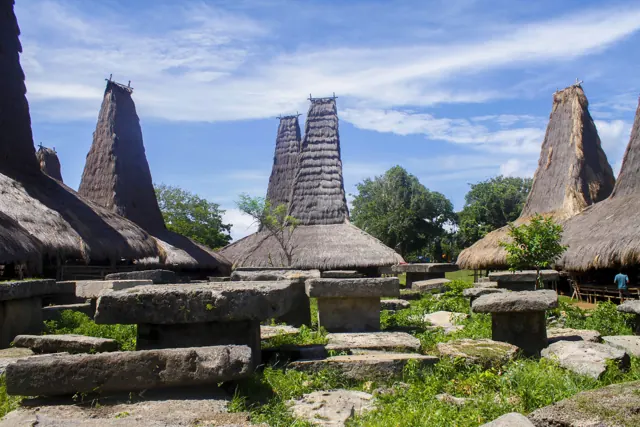
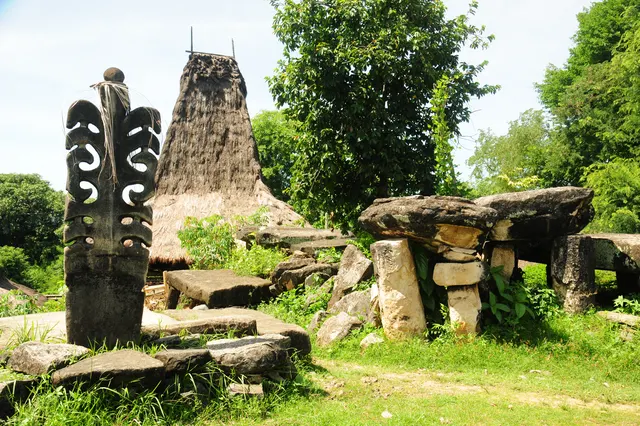
Stand in the harbour at Waingapu at dusk, with the fishing boats knocking against the jetty and the smell of diesel and dried fish in the air, and it is hard to imagine that this quiet bay was once the busiest horse port in the eastern islands. Or walk among the stone tombs of a western village and remember that the island's old name in Dutch records was the Sandalwood Island. Sumba's history is written less in books than in its landscape: in tombs, clan houses, horse herds and the bare hills where forests once stood.
The short answer: Sumba was home to clan-based chiefdoms with a megalithic burial tradition long before written records. From at least the 14th century it was linked to wider trade networks through sandalwood and horses, appearing in Javanese Majapahit sources as a vassal. In the 17th-19th centuries it was drawn into the orbit of Bima and Makassar and became a major source of slaves, while Endenese traders from Flores dominated its commerce. The Dutch signed a first contract with local chiefs in 1756 but only began full colonial control from 1906. Sumba became part of independent Indonesia, and today it is divided into four regencies with about 850,000 people.
Timeline at a glance
| When | What happened |
|---|---|
| Prehistory | Clan societies, urn burials (found at Melolo in the 1920s) and the beginnings of megalithic tombs |
| 14th century | The Nagarakretagama lists Sumba as a vassal of Majapahit; sandalwood and horses link it to trade |
| 1522 | First recorded contact with Portuguese explorers |
| 1636 | A Dutch VOC ship is wrecked on "Sandelbosch Eyland", the Sandalwood Island |
| 17th century | Loose overlordship of Bima (Sumbawa); Makassarese influence and tribute to Gowa |
| 1720s-1830s | Slave trade at its height; parts of the interior depopulated |
| 1756 | First VOC contract with a coalition of Sumbanese chiefs |
| 1841-1846 | Horse exports take off; over 4,000 horses shipped by 1846 |
| 1866 | Administration passes to the Netherlands East Indies government |
| 1886 | First Christian mission, in Laura, West Sumba |
| 1906 | Dutch military "pacification" of the island begins |
| 1945-1950s | Sumba becomes part of independent Indonesia |
| 1958 | East Sumba and West Sumba regencies created (Law 69/1958) |
| 1962 | Old domains replaced by districts under state-appointed heads |
| 1998 | Two national parks created; deadly violence in Waikabubak |
| 2007 | Central Sumba and Southwest Sumba split from West Sumba: four regencies |
Before the records: clans, stones and ancestors
The Sumbanese are of mixed Austronesian and Melanesian ancestry, and their society has long been organised in patrilineal clans (kabihu), each tracing itself to a founding ancestor. In East Sumba, identity traditionally came from one of about 50 independent domains (tana), each with a fortified hilltop ceremonial centre and its own ruler. Society was ranked: nobles (maramba), commoners and a class of dependants and slaves (ata).
Sumba's culture in your inbox
Marapu, ikat, horses and ceremonies, explained with care every Sunday.
One email a week. No spam. Unsubscribe in one click. Sumba this weekArchaeology has found urn burials at Melolo in East Sumba, discovered in the 1920s, and the megalithic tradition that still produces stone tombs today has very deep roots. These tombs, clan houses and rituals remain the living archive of the island; our guide to Marapu, ikat and traditional villages explains how.
Sandalwood, horses and the wider world
Sandalwood drew traders to the islands of the region for centuries; Chinese records from the 13th and 14th centuries describe the sandalwood of the eastern islands. By the 14th century, according to the Javanese court poem Nagarakretagama, Sumba was listed as a vassal of Majapahit, which in practice meant little more than a commercial relationship. Portuguese explorers made contact in 1522, and in 1636 a ship of the Dutch East India Company (VOC), the Maria, was wrecked on what Dutch sailors called Sandelbosch Eyland, the Sandalwood Island. The forests were gradually stripped: as late as 1775 a visitor still found sandalwood growing, though islanders were reluctant to fell the trees, and between 1838 and 1848 traders from Ende exported some 1,228 pikul of it. Little of that forest survives.
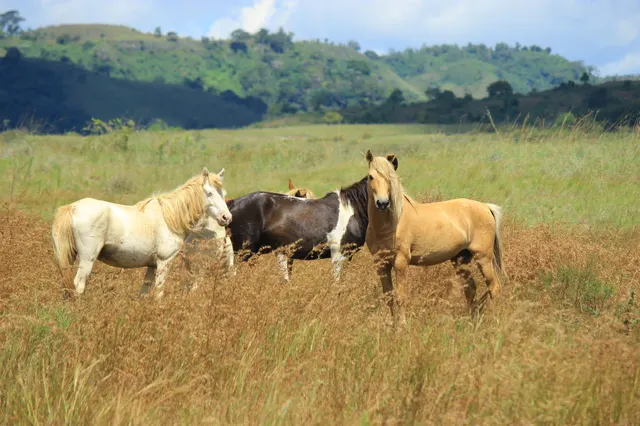
In the 19th century horses took over. In 1841 an Arab trader, Syarif Abdur Rahman, shipped a first batch of 98 Sumbanese horses; in 1843 he moved his operations to Nangamessi Bay, the site of today's Waingapu; and by 1846 more than 4,000 horses had been exported. The sturdy "Sandalwood pony" is still one of the island's emblems; see our guide to Sumba's horses.
Bima, Makassar, Ende and the slave trade
In the 17th century the sultanate of Bima, on neighbouring Sumbawa, claimed a loose hegemony over Sumba's chiefdoms, and a VOC report of 1650 described the island as under Makassarese control and sending tribute to Gowa and Talloq. The darker trade was in people. Local rulers sold captives to off-island dealers, and the slave trade peaked in the 18th century, largely depopulating parts of the interior. In the 1720s roughly a third of the slaves entering Makassar came from Sumba. In 1758 the largest recorded raid, by 24 boats, carried off hundreds of people from Kanatang and Melolo on the north and east coasts.
From the late 17th century, traders from Ende in Flores sailed to Sumba every year, and by 1831 they held a monopoly on its trade, arriving in flotillas of 50 to 100 boats. Muslim Endenese settled along the coast, originally as exporters of slaves. The Netherlands abolished slavery in its East Indies on 1 January 1860, but this had no effect on Sumba at first; slave exports only faded in the early 1860s, and raids on the interior continued for years.
The Dutch period
Dutch involvement was slow and uneven. The first senior VOC official visited in 1751, and in 1756 a contract of allegiance was concluded with a coalition of Sumbanese chiefs, although, according to later accounts, only one of the eight rulers named actually attended. A planned military campaign was shelved in 1775. The first Dutch official took up residence on the island in 1845, further treaties followed, and in 1866 the administration passed to the Netherlands East Indies government.
Missions came next. A Catholic mission was founded in 1886, in Laura in West Sumba, but soon abandoned; Christian missions later built the schools that the old elites used to train their children as officials. In the 19th century the Dutch also sponsored Christian settlers from the island of Savu. Around 1900 the colonial government began to intervene directly in local politics, ruling through chiefs it renamed "rajas", and in 1906 it launched the formal military "pacification" of the island. A civil administrator was installed some six years later, and in 1933 garrison troops were replaced by police.
Independence and the modern regencies
During the Second World War Sumba, like the rest of the Dutch East Indies, was occupied by Japan; caves dug in that period can still be seen on hills near Waingapu, such as Bukit Persaudaraan. After the war the island became part of the new Republic of Indonesia. In 1958 Law 69/1958 created the regencies of East Sumba and West Sumba within the new province of East Nusa Tenggara, and in 1962 the old domain-based divisions were replaced by districts under state-appointed heads (camat). Under the New Order (1966-1998) the state invested in schools, roads, electricity and health care.
The transition was not always peaceful. In November 1998 violence broke out in Waikabubak, West Sumba, between people from the Loli and Wewewa areas after a protest over corruption in civil-service recruitment; accounts of the toll vary, and one reference work puts it at over a hundred dead. The same year, Sumba's two national parks, Laiwangi Wanggameti and Manupeu Tanah Daru, were created; see our hiking guide. On 2 January 2007 two new regencies, Central Sumba and Southwest Sumba, were carved out of West Sumba, giving the island its present four regencies.
Sumba today
Sumba had an estimated 852,832 inhabitants in mid-2025, according to official figures compiled on Wikipedia. Most are Christian, while the ancestral Marapu religion remains central to ceremonies and identity, even among Christians. Farming, livestock and weaving support most families; tourism is growing but still small, with East Sumba counting 41,524 visitors in 2025. Land, once plentiful and rarely sold, has become one of the island's most sensitive issues, as our explainer on customary land in Sumba describes.
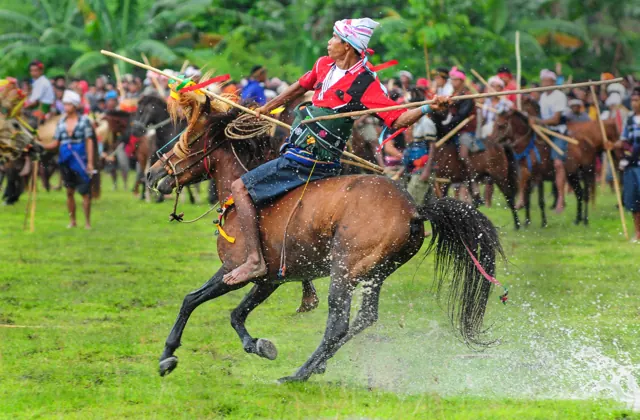
For today's numbers, from airports to distances, see Sumba in facts and figures. For the island's most famous ritual, read our Pasola explainer.
A note on sources
Much of what is written about Sumba's past comes from Dutch colonial records and later anthropological work, which see the island from the outside; Sumbanese oral histories, kept by clan elders, often tell the same events differently. Dates in this timeline come from encyclopedia entries and published historical research listed below. Where sources disagree, we say so.
Frequently asked questions
Why is Sumba called Sandalwood Island?
Because its sandalwood forests drew traders for centuries: 17th-century Dutch sailors called it Sandelbosch Eyland, and sandalwood was a key export. The forests were largely cut down by the 19th century; between 1838 and 1848 traders from Ende alone exported about 1,228 pikul.
When did the Dutch colonise Sumba?
Gradually. The VOC signed a first contract with a coalition of Sumbanese chiefs in 1756, a Dutch official took up residence in 1845 and administration passed to the Netherlands East Indies in 1866, but full control came only with the military pacification that began in 1906.
Was Sumba involved in the slave trade?
Yes, heavily. Local rulers sold captives to off-island dealers, and the trade peaked in the 18th century: in the 1720s about a third of the slaves entering Makassar came from Sumba, and raids depopulated parts of the interior. Exports only faded in the early 1860s.
When did the horse trade start in Sumba?
In 1841 the trader Syarif Abdur Rahman shipped a first batch of 98 horses, moved his base to Nangamessi Bay (today's Waingapu) in 1843, and by 1846 more than 4,000 horses had been exported.
How many regencies does Sumba have?
Four: East Sumba (Waingapu), West Sumba (Waikabubak), Central Sumba (Waibakul) and Southwest Sumba (Tambolaka). East and West Sumba were created in 1958; Central and Southwest Sumba were split from West Sumba on 2 January 2007.
Was Sumba part of Majapahit?
The 14th-century Javanese poem Nagarakretagama lists Sumba as a vassal of Majapahit, but historians describe the relationship as little more than commercial. Local clan chiefdoms remained independent in practice.
Places in this guide
- Waingapu · East Sumba · Open in maps
- Tarung village, Waikabubak · West Sumba · Open in maps
- Sumbanese, Worldmark Encyclopedia of Cultures and Daily Life (via Encyclopedia.com)
- Sumba: history (sandalwood, horses, slaves, the Dutch), David and Sue Richardson, Asian Textile Studies, 18 Mar 2018
- Sumba, Encyclopaedia Britannica
- Sumba, Wikipedia
Spotted an error? Write to info@ecobeachcity.com.
Sumba's culture in your inbox
Marapu, ikat, horses and ceremonies, explained with care every Sunday.
One email a week. No spam. Unsubscribe in one click. Sumba this week