Guide · Culture
Customary (adat) land in Sumba explained: clans, rights and disputes
Why most of Sumba's land belongs to clans rather than certificates, what masyarakat hukum adat means, and what it changes for buyers and visitors.
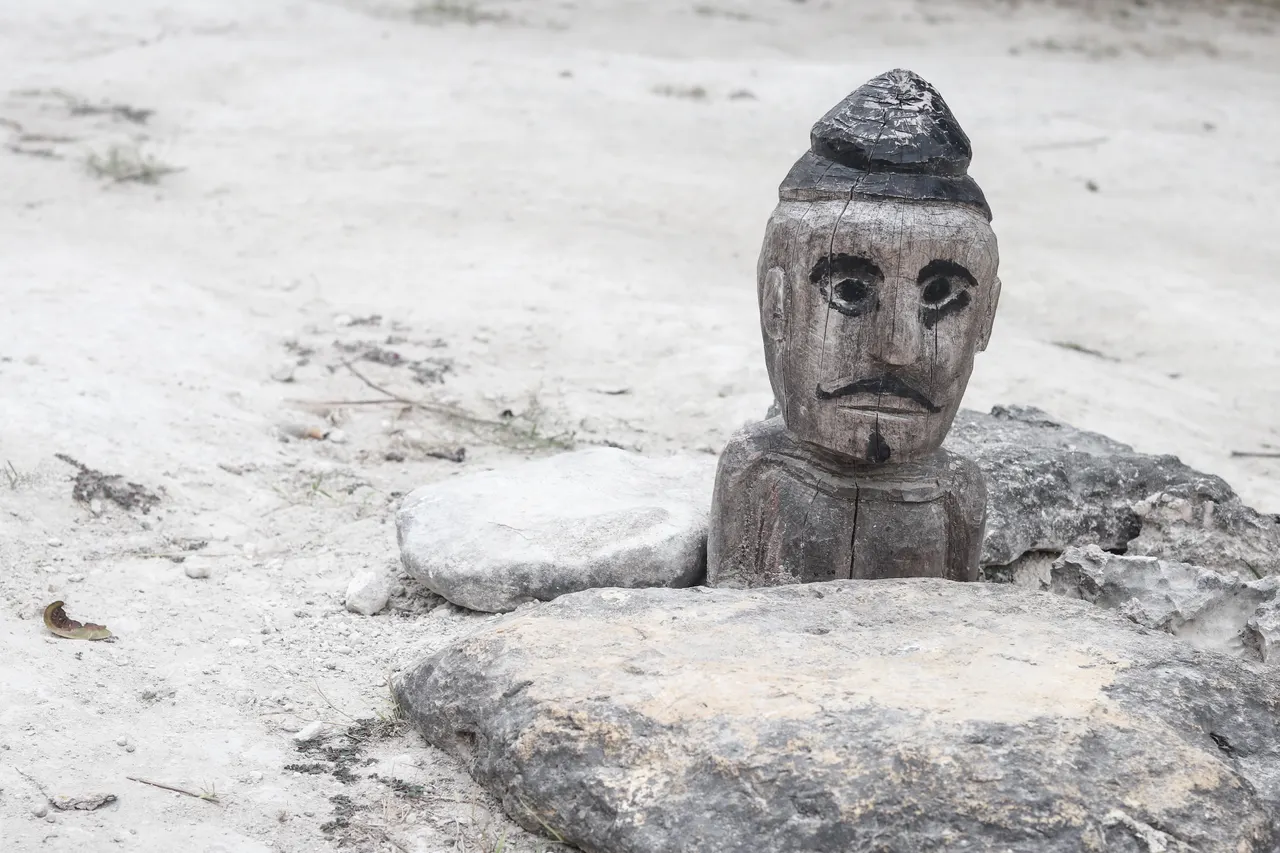
Much of Sumba is customary (adat) land held collectively by clans (kabihu) and governed by their elders, and Indonesian law recognises these customary law communities (masyarakat hukum adat) and their communal right over land (hak ulayat). Because little of this land is mapped or registered, overlapping claims, sales by people without full authority and old deals revisited when land gains value make disputes common. In November 2026 three East Sumba communities were applying for what could be NTT's first communal land certificate.
- Legal basis
- Constitution Art. 18B(2); Basic Agrarian Law 1960 (hak ulayat)
- Who holds it
- Clans (kabihu), through their elders and senior houses
- Registration
- ATR/BPN Regulation 14/2024; 57 HPL titles to 18 communities nationwide (2023-Sep 2025)
- Sumba milestone
- Three East Sumba communities applying for communal titles (Nov 2026)
- Main dispute causes
- Overlapping claims, sales without full authority, old deals, certificates over adat land
- For visitors
- Ask before camping or flying drones; pay customary fees; never touch tombs
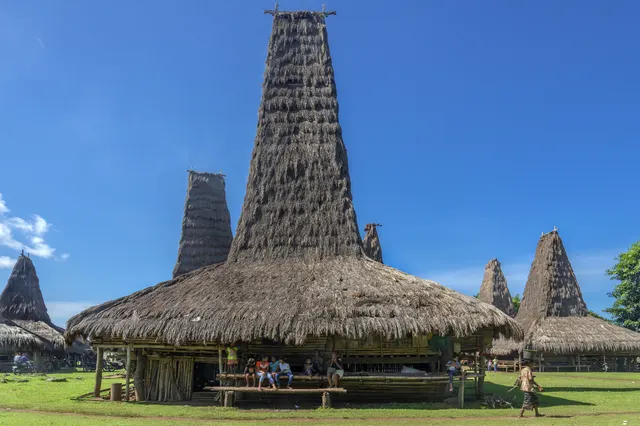
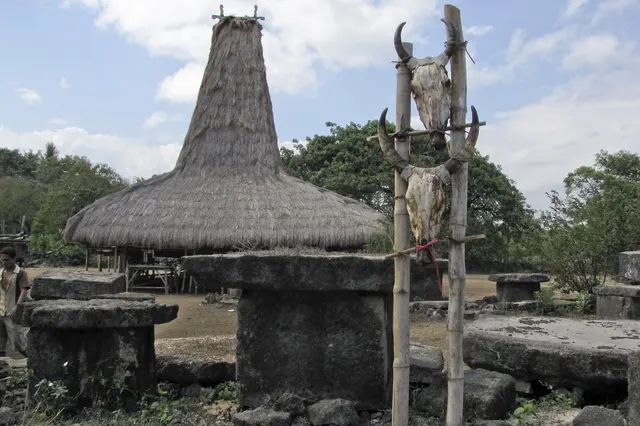
Drive across East Sumba in the dry season and the land seems to belong to no one: folded hills of pale grass, a line of lontar palms, a few horses, then nothing for kilometres. It is an illusion. Almost every slope, spring and stretch of beach is tied to a clan, a founding ancestor and a set of rules older than the Indonesian state. The stone tombs you pass at the edge of a village are not only graves; they are also a statement about who first opened that land.
The short answer: much of Sumba is customary (adat) land, held collectively by clans (kabihu) and governed by their elders rather than by a land certificate. Indonesian law recognises customary law communities, the masyarakat hukum adat, and their communal right over land (hak ulayat), but only a small part of that land has ever been mapped or registered. That gap between custom and paper is the main reason land disputes are common on the island, and it is what every buyer, investor and curious visitor needs to understand first.
What "masyarakat hukum adat" means
Masyarakat hukum adat translates as "customary law community": a group bound by descent or territory that still lives by its own customary rules, has its own institutions (elders, ritual leaders, a meeting house) and controls a defined territory. The Indonesian Constitution recognises these communities in Article 18B(2), which says the state recognises and respects customary law communities and their traditional rights "as long as they are still alive" and in line with the development of society and the unitary state. The Basic Agrarian Law of 1960 (UUPA) gives the concept of hak ulayat, the community's authority over the land, water, plants and animals of its territory.
Sumba's culture in your inbox
Marapu, ikat, horses and ceremonies, explained with care every Sunday.
One email a week. No spam. Unsubscribe in one click. Sumba this weekIn 2013 Indonesia's Constitutional Court (ruling 35/PUU-X/2012) went further for forests, ruling that customary forests belong to customary communities and should not be classed as state forest. For land outside forests, the Ministry of Agrarian Affairs and Spatial Planning (ATR/BPN) issued Regulation 14 of 2024 on the administration and registration of ulayat land. According to a Hukumonline report of September 2025, the ministry said it had issued 57 management-right certificates (Hak Pengelolaan, HPL) to 18 customary communities across Indonesia since 2023, covering about 987 hectares. Academics still debate whether giving communities an HPL title strengthens their rights or quietly turns customary land into state-administered land.
How customary land works in Sumba
Sumbanese society is organised in patrilineal clans, the kabihu. Each clan traces itself to a founding ancestor who first obtained the right to settle and work an area, and the clan's senior house keeps that memory alive in ritual. Researchers Jacqueline Vel and Stepanus Makambombu, who studied access to land justice in Sumba, describe the traditional pattern as tana kabihu: clan land where members may farm, gather and graze, and where outsiders need the clan leaders' permission. Over time, rice fields and house plots became "individual adat land", often backed only by village letters or land-tax receipts rather than a certificate.
Three features matter for anyone looking at a piece of land:
- Rights are layered. A family may farm a field, the clan may claim the wider territory, and the state may hold it on paper as state land. All three can be "true" at the same time.
- Not everyone speaks for the land. The same research found that companies and local governments often negotiated mainly with chiefs and landowners, leaving out landless cultivators, women and lower-status families who also depend on the land.
- Debts and pledges move land quietly. Under customary pledging, a lender can hold a field until a loan is repaid in full, so the person using a plot is not always its owner.
Why land disputes happen
Land on Sumba was long cheap and rarely sold. That changed as roads, airports and tourism made coastal and roadside land valuable. Disputes typically come from a few recurring situations:
- Overlapping claims. Two clans, or two branches of the same clan, remember the boundaries differently. Without maps, both versions survive.
- Sales by the wrong person. An individual sells land that the wider clan considers collective, or a sale is made while relatives who also hold rights are absent.
- Old deals, new value. Land "sold" decades ago for a small sum is contested once a project starts, especially when the original agreement was oral.
- Certificates over customary land. A certificate issued by the land office can clash with a community's claim that the land was never theirs to sell.
Disputes are usually settled "within the family" (secara keluarga) by elders, with village heads acting as mediators. Courts handle relatively few cases, partly because, as Vel and Makambombu note, customary norms require whole groups to attend and to be fed, which makes litigation expensive. Sometimes disputes turn violent. In April 2018, during a land survey for a tourism company in Patiala Bawa village, Lamboya district (West Sumba), a resident named Poroduka was killed. The company said it had bought about 50 hectares from residents in 1994 and held building-rights (HGB) certificates; residents said they had never sold the land, according to CNN Indonesia.
The first communal land certificates
A new chapter may be opening. In November 2026 East Sumba's deputy regent, Yonathan Hani, said three customary law communities were applying for communal certificates at the regency land office, and that one file was nearly complete. If issued, it could be the first customary land certificate in East Nusa Tenggara. The process requires a customary institution that is organised and formally recognised, and clearly defined communal rights over its territory. Read our news report: East Sumba could issue NTT's first customary land certificate.
Communal titles would not end every dispute, but they would put on paper who holds rights over an area, which is exactly what is missing today.
What it means for buyers and investors
If you are thinking of leasing land, building or investing, customary land is the first risk to understand, before price, view or access road. A land certificate checked at the land office (BPN) is essential, but it does not by itself settle customary claims. International law firm DFDL warned in 2026 that on uncertified or customary land backed by village letters or tax receipts, the seller may lack authority and adat or community claims "may be asserted after closing". Practical consequences:
- Ask who the land belongs to in custom, not only on paper, and which clan and elders must agree.
- Make sure the family members and clan representatives with rights are present and sign, not one intermediary.
- Check the history of the plot: earlier sales, pledges, disputes and graves or ritual sites on it.
- Use an independent notary and land deed official (PPAT) and a lawyer who works in the area.
Our guide to buying land or property in Sumba as a foreigner explains the legal titles (Hak Pakai, HGB, PT PMA) and the nominee trap. This page is general information, not legal advice.
What it means for visitors
For travellers, customary land is mostly invisible, but it shapes how you should move around:
- Beaches and fields are not public parks. A quiet beach may be clan land or sacred ground. Ask before camping, flying a drone or holding a party.
- Small fees are often customary. A parking charge or contribution at a village or viewpoint usually goes to the landholding community. Pay it with good grace.
- Graves and stones are on purpose. Megalithic tombs, standing stones and offering sites mark ancestral claims. Never sit on them or move anything.
- Stay out of disputes. If you see a barricade, a sign reading tanah sengketa (disputed land) or a tense gathering, turn back.
To understand the belief system behind all this, read our guide to Marapu, ikat and traditional villages, and for the island's past, a short history of Sumba.
Key terms
| Term | Meaning |
|---|---|
| Adat | Custom, customary law |
| Masyarakat hukum adat | Customary law community recognised by the state |
| Hak ulayat | A community's collective right over its territory |
| Kabihu | Sumbanese patrilineal clan |
| Tanah sengketa | Disputed land |
| BPN / ATR | National Land Agency / Ministry of Agrarian Affairs |
| HPL | Management right, the title now used for some registered customary land |
Frequently asked questions
What is adat land in Sumba?
Adat land is customary land held collectively by a clan (kabihu) and managed by its elders under customary law, often without a state land certificate. Individual families may farm parts of it, but the wider territory is tied to the clan and its founding ancestor.
What does masyarakat hukum adat mean?
It means customary law community: a group that still lives by its own customary rules, has its own institutions and controls a defined territory. The Indonesian Constitution (Article 18B(2)) recognises these communities and their traditional rights as long as they are still alive.
Why are there so many land disputes in Sumba?
Because most land was never mapped or registered, rights overlap between families, clans and the state, and land gained value with roads and tourism. Disputes arise from overlapping boundaries, sales by people without full authority, old oral deals and certificates issued over land a community considers customary.
Can customary land be sold to a foreigner?
Foreigners cannot hold freehold (Hak Milik) land in Indonesia at all. Beyond that, buying or leasing customary land carries the risk that clan members later contest the deal, so any transaction needs a checked certificate, the agreement of all rights holders and independent legal advice.
Has Sumba issued communal land certificates?
Not yet, as of 10 November 2026. In November 2026 East Sumba's deputy regent said three customary communities were applying at the regency land office and one file was nearly complete, which could become the first customary land certificate in East Nusa Tenggara.
Do visitors need to worry about adat land?
Not much, but it explains local rules. Beaches and grasslands may belong to clans, small fees often go to the landholding community, and tombs and ritual stones must not be touched. Ask before camping or flying a drone, and avoid any area marked as disputed.
Places in this guide
- Waingapu · East Sumba · Open in maps
- Marosi beach (Lamboya) · Lamboya, West Sumba · Open in maps
- Dalam acara temu pisah Kepala ATR/BPN Sumba Timur, semangat sertifikasi tanah adat menggema, Waingapu.Com, 7 Nov 2026
- Access to Agrarian Justice in Sumba, Eastern Indonesia, J. Vel and S. Makambombu, Law, Social Justice and Global Development Journal, 2010
- Sertifikat HPL atas tanah ulayat: antara kepastian hukum dan kritik akademisi, Hukumonline, 27 Sep 2025
- Kronologi konflik lahan tewaskan warga NTT, CNN Indonesia, 30 Apr 2018
- Land purchase disputes in Indonesia: what foreign investors need to know, DFDL, Jul 2026 (updated Aug 2026)
- Indonesia's Constitutional Court ruling on customary forests, REDD-Monitor, 2013
Spotted an error? Write to info@ecobeachcity.com.
Sumba's culture in your inbox
Marapu, ikat, horses and ceremonies, explained with care every Sunday.
One email a week. No spam. Unsubscribe in one click. Sumba this week