Travel
Prailiu village, Sumba: the royal weaving village in Waingapu
Tall thatched roofs, carved stone tombs and the click of backstrap looms, a few minutes from Waingapu airport: how to visit Kampung Raja Prailiu respectfully.
Kampung Raja Prailiu is a traditional royal village inside Waingapu, in Kambera district, roughly halfway between Umbu Mehang Kunda airport and the town centre. It is known for megalithic tombs and ikat weaving; there is no fixed entrance fee, but visitors sign the guest book and leave a small donation, and weaving is usually not shown on Sundays.
- Where
- Kambera district, Waingapu town, East Sumba
- From the nearest airport
- Waingapu (WGP): roughly 5-10 minutes by road
- Best time
- Monday-Saturday, morning or mid-afternoon
- Entry
- No ticket; sign the guest book and leave a donation
- Good for
- Watching ikat weaving, megalithic tombs, a first look at Sumbanese culture
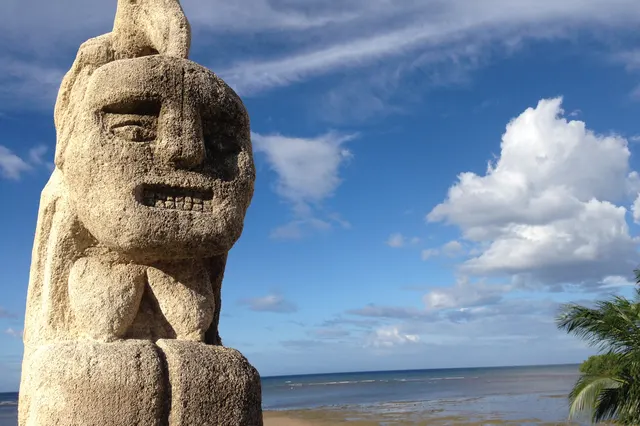
Step off the busy road in east Waingapu and the noise drops away. Under the high peaked roofs of the old houses, women sit on mats with backstrap looms tied around their waists, sliding threads through by hand, the wooden beater knocking softly with each pass. Between the houses stand heavy stone tombs, their slabs carved with crocodiles, turtles and horses. Chickens wander, a child runs past, someone offers you a seat on the veranda. A town is all around you, and yet this is clearly another world.
Prailiu is the easiest traditional village to visit in East Sumba, and a good first lesson in Sumbanese culture and ikat.
What it is and why go
Kampung Raja Prailiu ("royal village of Prailiu") is in Kambera district of Waingapu town. Residents say it was once the seat of one of the kingdoms of Sumba; a noble from the village was chosen as raja during Dutch colonial rule. The last king, Umbu Djaka, died in 2008, and his stone tomb, reported to weigh around 40 tons, is the most elaborate in the village.
Low Tide, every Sunday
One short letter a week about living well, from an island with more horses than traffic lights. Free.
We only use your email to send the letter. Unsubscribe in one click.The traditional houses, called uma mbatangu or uma hori, have tall tower roofs and three levels: in Sumbanese belief, one for the dead or the animals below, one for the living, and the roof for the ancestors and spirits. Carvings on the tombs show the rank of the dead. The village is tied to the Marapu belief system, though many families are now also Christian.
Above all, Prailiu is a weaving village. Women spin, tie, dye with natural materials and weave hinggi and lau cloths, with motifs of horses, crocodiles, prawns and past rulers. Weaving is a main source of income, and in December 2025 Indonesia's Minister of Culture visited the village's ikat gallery as part of a push to protect its heritage.
How to get there
Prailiu is on the eastern side of Waingapu, roughly halfway between the airport and the town centre; the entrance is marked by a statue of a man on horseback with a turtle and crocodile. It is about 15 minutes on foot from the centre or a few minutes by car, ojek or scooter.
- From Waingapu airport (WGP): roughly 5-10 minutes by road; an easy stop on arrival or departure.
- From Tambolaka (TMC): about 170 km and 4-5 hours to Waingapu.
No guide is needed, but a local driver or guide can translate and help you understand what you see.
When to go and best time of day
- Days: come Monday to Saturday. On Sundays many residents are at church and weaving is usually not on show.
- Time: mornings and mid-afternoon are good for watching the weavers in shade. Avoid arriving around midday meal times.
- Season: any time of year. Funerals and other ceremonies are family events: if one is under way, ask whether visitors are welcome before entering.
Tips and etiquette
- Donation: there is no ticket. Sign the visitors' book and leave a contribution; around IDR 20,000-50,000 per person is a common amount, but it is up to you.
- Greeting: you may be welcomed with sirih pinang (betel leaf and areca nut), the traditional gesture of hospitality. Accept politely, even if you do not chew it.
- Photos: always ask before photographing people, the weavers and the inside of houses.
- Tombs: do not sit on, climb or touch the tombs, and keep away from ritual objects.
- Dress: cover shoulders and knees.
- Buying ikat: there is little hard sell. Hand-spun, naturally dyed cloth can take months to make, so prices are high; a large hinggi can cost several million rupiah (2025-2026, prices vary widely). Ask how it was made, and buy because you love it, not to be polite.
Nearby
- Waingapu town, the market, the old harbour and grilled fish.
- Walakiri Beach, half an hour east for sunset.
- Rende and Pau, the royal and weaving villages of the south-east.
Read more in our guide to Marapu, ikat and the traditional villages.
Frequently asked questions
Where is Prailiu village?
Inside Waingapu town, on the east side between the airport and the centre, in Kambera district. It is about 15 minutes on foot from the town centre.
Is there an entrance fee at Kampung Raja Prailiu?
No ticket, but visitors sign the guest book and leave a donation. Around IDR 20,000-50,000 per person is common.
Can you watch ikat weaving at Prailiu?
Usually yes, from Monday to Saturday. On Sundays many residents are at church and weaving is often not on show.
Can I buy ikat in Prailiu?
Yes, directly from weavers and a village gallery. Hand-spun, naturally dyed cloth takes months to make and large pieces can cost millions of rupiah.
Places in this guide
- Kampung Raja Prailiu · East Sumba · Open in maps
- Mai La Humba, belajar budaya di Kampung Adat Raja Prailiu, detikcom, 4 Dec 2023
- Kementerian Kebudayaan perkuat pelindungan budaya Sumba Timur, fokus warisan Prailiu, Merdeka, Dec 2025
- 3 special facts of East Sumba's Prailiu King Village, Tempo English
- Ikat at Prailiu village, Travelfish
- Unexpected attractions around Waingapu, East Sumba, Live the World
- Sumba: around Waingapu and Melolo, The Spice Route End (travel blog), 2018
Spotted an error? Write to info@ecobeachcity.com.
Low Tide, every Sunday
One short letter a week about living well, from an island with more horses than traffic lights. Free.
We only use your email to send the letter. Unsubscribe in one click.