Travel
Ratenggaro village, Sumba: how to visit respectfully
Towering thatched roofs and centuries of stone tombs on a lagoon by the Indian Ocean: how to reach Ratenggaro, what to give, what to avoid and when to go.
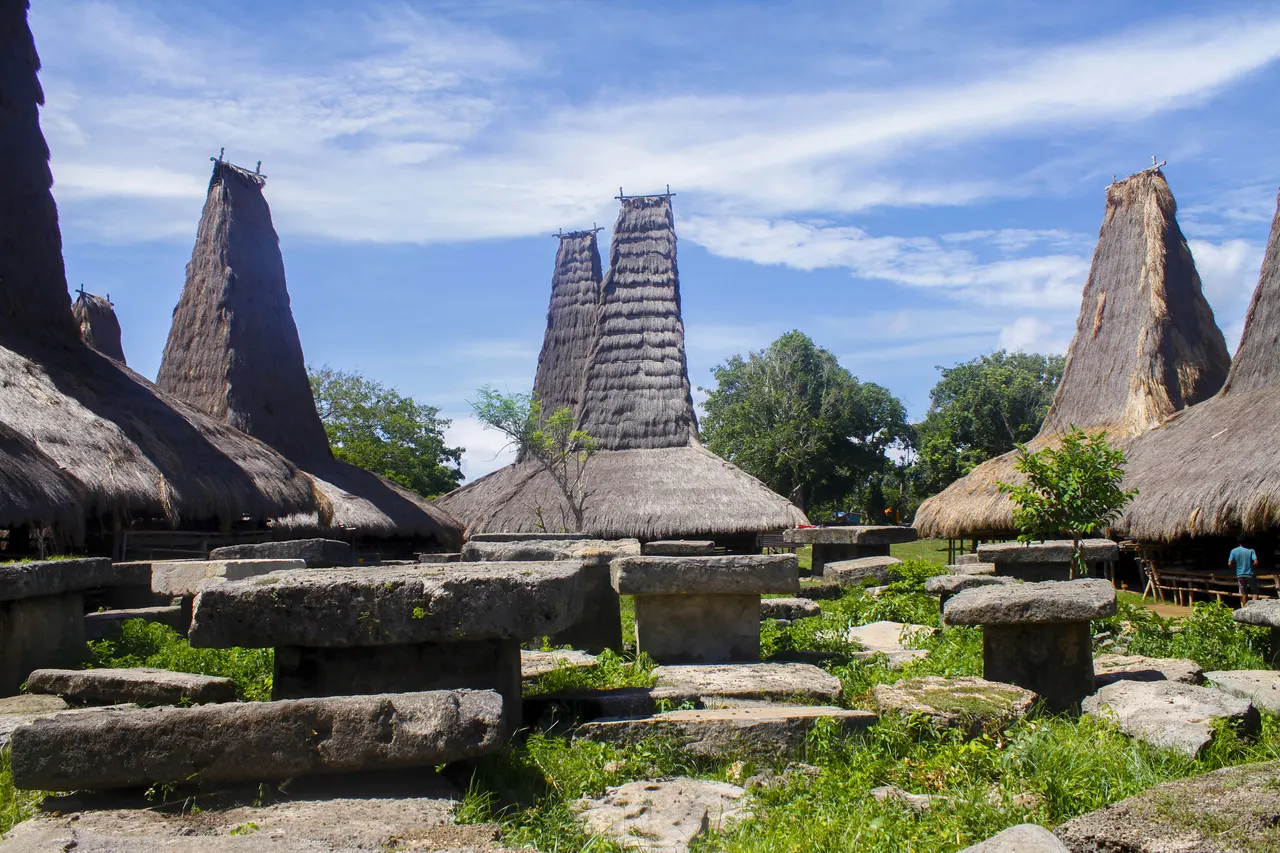
Ratenggaro is a traditional Marapu village in Kodi Bangedo, Southwest Sumba, known for houses with towering thatched roofs and hundreds of megalithic stone tombs by the sea. It is roughly 50-56 km from Tambolaka, about 1-1.5 hours by car on a mostly paved road. Visitors are expected to sign the guest book and leave a donation of around IDR 20,000 or more per person (2025-2026), ask before taking photos and never touch graves or ritual objects.
- Where
- Desa Maliti Bondo Ate, Kodi Bangedo, Southwest Sumba
- From the nearest airport
- Tambolaka (TMC): roughly 50-56 km, about 1-1.5 hours by car
- Best time
- Year-round; dry season (roughly May-September) for easier roads; morning light
- Entry
- Guest book and donation, around IDR 20,000+ per person (2025-2026)
- Good for
- Traditional architecture, megalithic tombs, Marapu culture, ikat
The roofs appear first, above the coconut palms: tall, narrow cones of thatch rising from the houses like the hulls of upturned boats, darker at the top where the smoke of cooking fires has seeped through for years. Below them, flat slabs of stone lie everywhere, some on short pillars, some carved, some green with moss. Chickens scratch between the graves, a woman sits weaving under a veranda, and beyond the last house the river opens into a turquoise lagoon and then the Indian Ocean.
Ratenggaro is one of the most visited traditional villages in Sumba, and also a living home. This page explains what you are seeing, how to get there and how to visit in a way that leaves a good impression for the next traveller.
What Ratenggaro is and why go
Ratenggaro (Kampung Adat Ratenggaro) sits on the coast of Desa Maliti Bondo Ate in Kodi Bangedo district, Southwest Sumba, on one side of a river estuary. Its residents follow Marapu, the ancestral belief of Sumba (see Marapu, ikat and traditional villages). The name is often explained as rate (grave) and garo, the people of Garo, recalling an old war.
- The houses: the stilt houses have tower roofs that are among the tallest in Sumba. Figures vary from about 15 m to around 25-30 m depending on the source; the tall roof holds the space for the ancestors and heirlooms. An Indonesian report says four sacred houses face each other at the cardinal points. The village is reported to have burned and been rebuilt with government help.
- The tombs: large megalithic graves stand in the village and along the shore. One Indonesian report counts about 304 stone graves, including those of the founders. Some tombs line the coast about 500 m from the houses.
- The setting: few villages in Sumba sit so close to the sea. Across the estuary you can see the roofs of Wainyapu.
How to get to Ratenggaro
Ratenggaro is roughly 50-56 km from Tambolaka, south-west of town. Allow about 1-1.5 hours by car on a mostly paved road, longer with stops.
- From Tambolaka (TMC): car with driver, around IDR 1,000,000-1,500,000 (about EUR 50-75 / USD 60-90) per day in 2025-2026; prices vary. A local guide or driver who knows the families makes the visit easier and more meaningful.
- Public transport: shared minibuses run from Waitabula to Bondo Kodi; then an ojek for the last stretch.
- On foot from Pero: about 40 minutes along the shore from Pero.
- From Waingapu (WGP): roughly 4-6 hours by road to Tambolaka first; plan a night in the west.
When to go and best time of day
Any time of year works, but the dry season (roughly May to September) makes roads easier. Morning light is soft on the roofs, and a late-afternoon visit can be combined with sunset at nearby beaches. In February the Kodi Pasola takes place in this area; dates are set by the Rato elders following the nyale sea worms, so confirm locally (see Pasola explained). If a funeral or ceremony is under way, ask whether visitors are welcome before entering.
Tips and etiquette
- Donation: sign the guest book and leave a contribution, around IDR 20,000 per person or more (about EUR 1.20 / USD 1.20) in 2025-2026. Extra small fees may apply to try on traditional clothing or enter a house. In May 2025 a video of visitors being pressed for money here went viral, and the provincial government said it would set up tourism groups (pokdarwis) to manage fees; give through the book or a recognised person, not to whoever asks.
- Children: children may ask for money or sweets. It is kinder to give to the donation book, or bring school supplies to hand to adults.
- Betel: a small gift of betel nut and areca (sirih pinang) is a traditional greeting and is appreciated.
- Respect: this is a home, not a museum. Ask before photographing people or entering a house, dress modestly, and never sit on, climb or touch the tombs or ritual objects.
- Safety: do not swim in the estuary: crocodile warning signs here are taken seriously. Use the sea beach only on calm days.
- Buying: villagers sell ikat and small carvings, usually with little pressure. Buying directly is a good way to support the community.
Nearby
- Wainyapu village: across the estuary, one of the largest villages in Kodi.
- Pero Beach: fishing village and sunsets, about 6 km north-west.
- Weekuri Lagoon: for a swim, about 45 minutes to an hour north.
- Kodi: the region, its people and the Pasola.
Frequently asked questions
How much does it cost to visit Ratenggaro village?
There is no fixed ticket. Visitors sign a guest book and leave a donation, around IDR 20,000 per person or more in 2025-2026, with small extra fees for trying on traditional clothing or entering a house.
How tall are the roofs at Ratenggaro?
Among the tallest in Sumba. Sources give figures from about 15 m up to around 25-30 m.
Can I take photos in Ratenggaro?
Yes, of the village and roofs, but ask before photographing people or entering a house, and do not climb or sit on the tombs.
Can you swim at Ratenggaro?
Not in the estuary, where there are crocodile warnings. The sea beach is only for calm days.
How far is Ratenggaro from Tambolaka?
Roughly 50-56 km, about 1-1.5 hours by car on a mostly paved road.
Places in this guide
- Ratenggaro village · Southwest Sumba · Open in maps
- Menapaki warisan budaya megalitikum tanah Sumba di Desa Adat Ratenggaro, Good News From Indonesia, 17 January 2025
- Ratenggaro Village, Travelfish
- Pemprov NTT segera bentuk pokdarwis buntut pemalakan YouTuber di Ratenggaro, detikBali, 20 May 2025
- Itinerary wisata sehari di Sumba, Popbela, 18 April 2026
- What to Do in Southwest Sumba: Top Places and Tips, Backindo, 2025 (updated 2026)
- Sumba: Kodi and Southwest Sumba, The Spice Route End
- Pantai Ratenggaro, Direktori Pariwisata
Spotted an error? Write to info@ecobeachcity.com.
Low Tide, every Sunday
One short letter a week about living well, from an island with more horses than traffic lights. Free.
We only use your email to send the letter. Unsubscribe in one click.