Place · Travel
Lambanapu, Sumba: an ancient burial site, a museum and ikat
On the edge of Waingapu, archaeologists found graves about 2,600 years old; today the village has a small museum and weavers who still dye with plants.
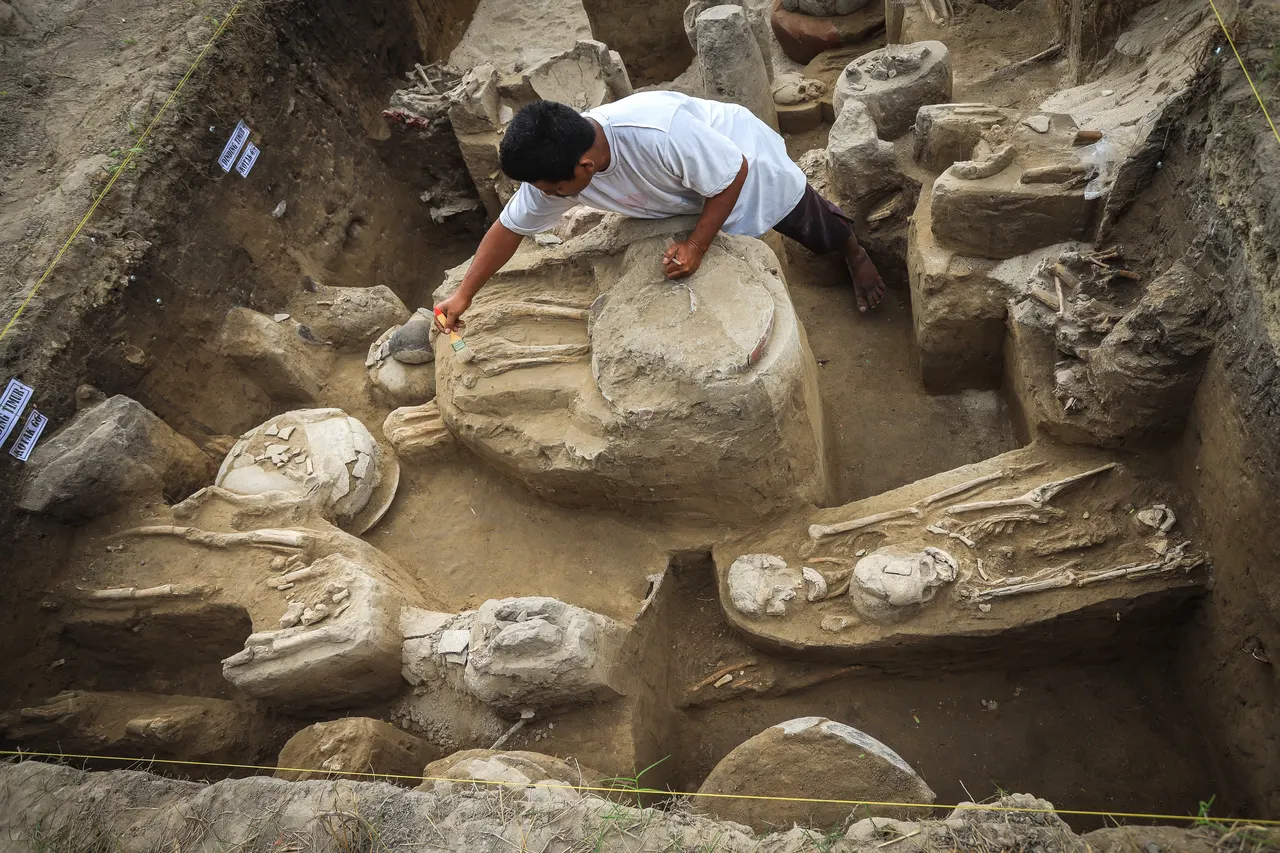
Lambanapu is a village (kelurahan) in Kambera district, just south of Waingapu town, East Sumba. BRIN archaeologists excavated an ancient burial site here in 2015-2016, finding 52 ancestral tombs and 58 graves without containers, dated to about 2,600 years ago. Good News From Indonesia (2025) describes a Lambanapu Museum and a weaving community; it is an easy half-day visit from Waingapu.
- Where
- Kambera district, just south of Waingapu town, East Sumba
- From the nearest airport
- Waingapu (WGP): a short drive, roughly 15-20 minutes
- Best time
- All year; mornings for weaving
- Entry
- No published museum fee; donations in houses
- Good for
- Archaeology, a small museum, naturally dyed ikat
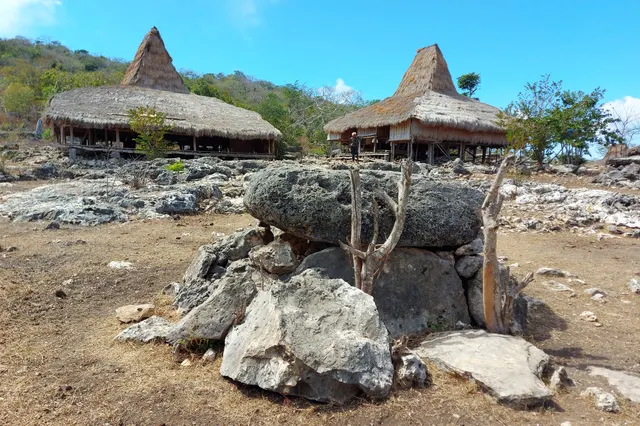
Rice fields, a river, low hills of savanna, houses with weaving looms under the eaves. Nothing on the surface tells you that beneath this ground, people were burying their dead with rings, beads and decorated pottery long before Sumba had its first written records. In Lambanapu, a few kilometres from Waingapu's airport, the island's deep past and its living craft sit side by side.
It is one of the easiest cultural visits from Waingapu, and one of the least known.
What it is and why go
Lambanapu is a kelurahan (urban village) in Kambera district, East Sumba Regency. In July 2024 detikInet reported on research by BRIN, Indonesia's national research and innovation agency, at three Sumba sites: Lambanapu, Mborombaku and Melolo. At Lambanapu, excavated in 2015-2016, researchers recorded 52 ancestral tombs and 58 graves with no burial container, along with clay vessels resembling kendi (water jugs) with decorations, rings and beads, and dated the site to about 2,600 years ago. Good News From Indonesia (October 2025) describes Lambanapu as one of the two oldest known settlement sites on Sumba.
Sumba this week, every Sunday
The week's news, one place worth the trip and practical travel notes. Free, and you get our 7-day Sumba guide (PDF) on signing up.
One email a week. No spam. Unsubscribe in one click. Sumba this weekThe same 2025 article describes the Lambanapu Museum, used for tourism and education, and the village's ikat weaving, made for weddings, funerals and ceremonies. Weavers face a shortage of natural dye materials and of young people willing to learn, and some still make red from mengkudu (morinda) roots. A community programme backed by the Astra group trains residents in tourism and in marketing their cloth.
How to get there
- From Waingapu town: Lambanapu lies just south of the town in Kambera district; on OpenStreetMap the kelurahan centre is about 5-6 km in a straight line from central Waingapu. Allow 15-20 minutes by car or ojek.
- From Waingapu airport (WGP): a short drive; it fits easily into an arrival or departure day.
- From Tambolaka (TMC): about 4-5 hours to Waingapu first.
Ask your driver for the museum and the weavers; signage may be limited, and opening hours are not published, so call ahead through a local guide if you can.
When to go and best time of day
Any time of year. Mornings are best for weaving, which usually happens in the cooler hours, and for catching people at home. Avoid Sunday mornings, when many families are at church.
Tips and etiquette
- Museum: no ticket price is published. Bring cash for a contribution or entry fee.
- Archaeology: graves are graves. Never dig, pick up pottery fragments or walk on marked burial areas.
- Weaving: ask before photographing weavers and their work, and buy directly if you like a piece. Ask which dyes were used; natural dyes take far longer and cost more. See Sumba ikat: where to buy.
- Donations: if you visit houses or a traditional compound, sign any guest book and leave a donation (around IDR 10,000-40,000 per person is common in Sumba, 2025-2026).
- Dress modestly and keep voices low near graves.
Plan your visit
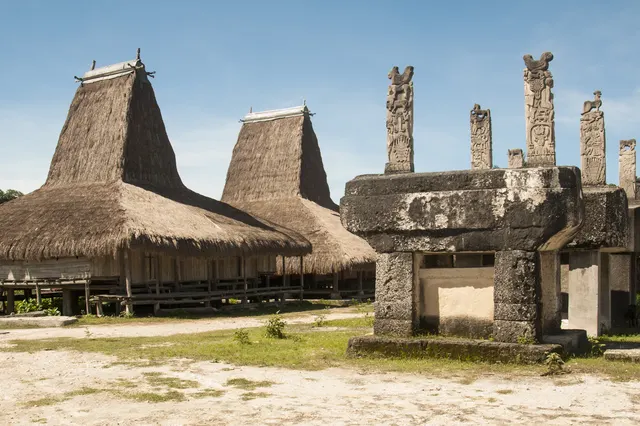
Lambanapu fits neatly into a first afternoon in Waingapu: land, drop your bags, visit the museum and the weavers, then head to Bukit Persaudaraan opposite the airport for sunset. For a full cultural day, add Prailiu in the morning and Kawangu after lunch, which lets you compare three very different faces of East Sumba: royal houses, ancient graves and the cloth trade. If you are interested in archaeology, ask locally whether someone connected with the museum can explain the excavations; the BRIN findings published in 2024 place Lambanapu among the key sites for understanding how Sumba was first settled.
Nearby
- Bukit Tanau, a sunrise savanna hill in the same district.
- Bukit Persaudaraan, Waingapu's sunset hill opposite the airport.
- Prailiu, the royal village of Waingapu, known for ikat.
- Kawangu, east of Waingapu, with dozens of stone tombs.
Frequently asked questions
What was found at Lambanapu?
According to BRIN research reported by detikInet in 2024, excavations in 2015-2016 found 52 ancestral tombs and 58 graves without containers, plus decorated clay vessels, rings and beads, dated to about 2,600 years ago.
Where is Lambanapu?
In Kambera district, just south of Waingapu town and close to the airport, East Sumba.
Is there a museum in Lambanapu?
Yes. Good News From Indonesia (2025) describes the Lambanapu Museum, used for tourism and education. Opening hours and fees are not published; ask a local guide.
Places in this guide
- Lambanapu (kelurahan centre) · Kambera, East Sumba · Open in maps
Distances by road
Lambanapu is in Kambera, East Sumba, on the island of Sumba, Indonesia: 176 km by road from Tambolaka Airport (TMC) (about 4 h 10 min to 5 h 10 min) and 8.1 km from Waingapu Airport (WGP) (about 10 min to 15 min).
- Regency
- East Sumba (Sumba Timur)
- From Tambolaka Airport (TMC)
- 176 km by road, about 4 h 10 min to 5 h 10 min driving
- From Waingapu Airport (WGP)
- 8.1 km by road, about 10 min to 15 min driving
- Nearest town
- Waingapu: 5.8 km by road, about 10 min
- Coordinates
- -9.6964, 120.2722 · Open in Google Maps ·
- Sunrise and sunset
- Sunrise from 05:27 (November) to 06:17 (July); sunset from 17:45 (May) to 18:27 (January), local time (WITA). Calculated for these coordinates on the 15th of each month.
Combine it in one day. The closest places by road from here, with the driving time between them:
- Prailiu village4.7 km · 5 min to 10 min
- Bukit Tanau4.8 km · 5 min to 10 min
- Waingapu5.7 km · 10 min
Road distances were calculated on 18 November 2026 with the OSRM routing engine on OpenStreetMap roads. Driving times are our estimate at an average of 34 to 42 km/h without long stops, the pace at which the 170 km between Tambolaka and Waingapu take 4 to 5 hours. All distances between towns and places →
Nearby places
- Bukit Tanau3 km straight-line (map point approximate)
- Bukit Persaudaraan4 km straight-line
- Prailiu village4 km straight-line
- Waingapu5 km straight-line
Straight-line distances between map points; roads are longer. Getting around Sumba: car with driver, scooter, buses and real driving times
- Peneliti BRIN ungkap Pulau Sumba dihuni manusia sejak 2.800 tahun lalu, detikInet, 17 Jul 2024
- Menyusuri Lambanapu, Desa Sejahtera Astra yang menjadi saksi hidup sejarah Sumba, Good News From Indonesia, 16 Oct 2025
- Kelurahan Lambanapu, OpenStreetMap / Nominatim (area coordinates)
Spotted an error? Write to info@ecobeachcity.com.
Sumba this week, every Sunday
The week's news, one place worth the trip and practical travel notes. Free, and you get our 7-day Sumba guide (PDF) on signing up.
One email a week. No spam. Unsubscribe in one click. Sumba this week