Place · Travel
Kaliuda, Sumba: the ikat village of the south-east coast
Red morinda and deep indigo, men's blankets made in pairs, and a 100-metre cloth that set a record: visiting Kaliuda's weavers and buying with care.
Kaliuda is a weaving village in Pahunga Lodu district on the south-east coast of East Sumba, about 100 km and roughly two hours by road from Waingapu. It is known for naturally dyed hinggi (men's blankets, called inggi here) in morinda red and indigo, and its weavers made a 100-metre ikat that the Indonesian record museum MURI recognised in 2012. Visit with a local guide, ask before photographing and buy directly from weavers.
- Where
- Pahunga Lodu district (Mangili area), south-east coast of East Sumba
- From the nearest airport
- Waingapu (WGP): about 100 km, roughly 2 hours by car
- Best time
- Dry season (roughly May-November in the east); mornings
- Entry
- No ticket; guest book and donation
- Good for
- Naturally dyed ikat, meeting weavers, buying at the source
Under the raised floor of a house, in the shade, a woman sits with her legs stretched out and a backstrap loom tied around her waist. Beside her, bundles of thread hang dyed a rust red so deep it is almost brown, and others a blue that goes black in the shadow. A child sorts candlenuts, a cockerel calls, and every few seconds comes the soft thud of the beater pressing another thread into place.
Kaliuda is one of the places where East Sumba's ikat still begins from the plant and the root. It is a working village, not a showroom, and it rewards patience.
What it is and why go
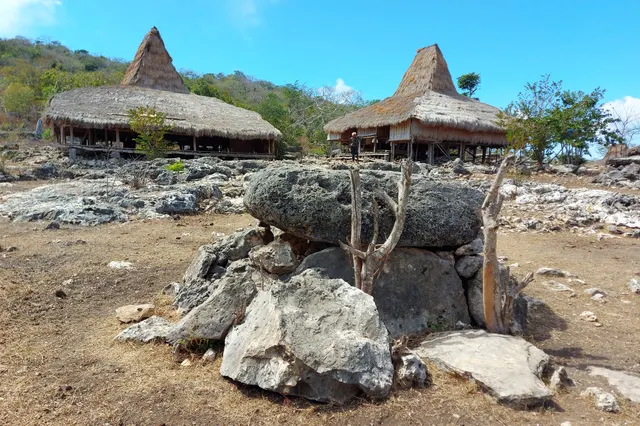
Kaliuda is a village (desa and kampung) in Pahunga Lodu district, East Sumba, in the area long known as Mangili. Asian Textile Studies, a detailed research site on Indonesian textiles, places it about 100 km south of Waingapu on a dry coastal plain about 3.5 km from the beach, and counted around 3,000 inhabitants in 2002, Sumbanese and Savunese. The same source describes the Mangili men's blanket, the inggi (hinggi elsewhere), always made in pairs, with three local types: red and black bands, red-black-white bands, and indigo blue and white. Weavers here dye with morinda root for red and indigo for blue, and Asian Textile Studies notes that the Mangili weavers' output remains naturally dyed.
Sumba this week, every Sunday
The week's news, one place worth the trip and practical travel notes. Free, and you get our 7-day Sumba guide (PDF) on signing up.
One email a week. No spam. Unsubscribe in one click. Sumba this weekIn December 2012, JPNN reported, a 100-metre ikat called "Ndendi Ndua", woven by a group from Kaliuda on their own initiative, received a MURI (Indonesian record museum) certificate in Waingapu. Read our guide to Sumba ikat and where to buy it before you go.
How to get there
- From Waingapu (WGP): about 100 km, roughly 2 hours by car, via Melolo on the south-east road.
- From Melolo: continue south along the coast; your driver will know the turn.
- From Tambolaka (TMC): too far for a day; base yourself in Waingapu.
Go by car with a driver or guide; there is no regular public transport geared to visitors. A guide who knows the weavers makes the visit far more rewarding.
When to go and best time of day
Any time of year can work, but the dry season (roughly May-November in the east) makes the south-east roads easier. Mornings are best: it is cooler, and dyeing and weaving are usually under way. Avoid arriving unannounced on Sunday mornings, when many families are at church, or during funerals and ceremonies.
Tips and etiquette
- Donation: sign the guest book and leave a donation; around IDR 10,000-40,000 per person is common in Sumbanese villages (2025-2026).
- Buying: a good naturally dyed pair of blankets represents months or years of work, and prices reflect that. Ask who made the cloth and with which dyes. Asian Textile Studies warns that many cheap Mangili-style blankets sold elsewhere are synthetically dyed imitations made in Kawangu, near Waingapu.
- Photos: ask before photographing weavers or their work; offering to buy something or leaving a contribution is good manners.
- Do not handle: do not touch threads on the loom or bundles in the dye pots without permission.
- Dress modestly and carry cash; there are no card payments.
Plan your visit
A good south-east day from Waingapu: leave early, stop at Pau or Rende near Melolo, reach Kaliuda by late morning while weaving is under way, then continue to Kalala beach for the afternoon or turn back towards Waingapu via Waimarang waterfall. If you want to buy, set a budget in advance, ask to see work in progress as well as finished pieces, and take your time; good conversations about cloth rarely happen in a hurry.
Nearby
- Melolo, the old Savunese settlement on the road from Waingapu.
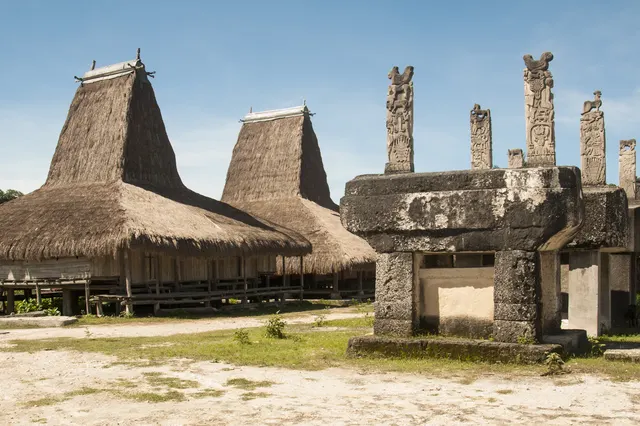
- Rende (Praiyawang), with great stone tombs and royal houses.
- Pau, another traditional village of the Melolo delta.
- Kalala beach, further south near Baing.
Frequently asked questions
What is Kaliuda known for?
Naturally dyed ikat, especially pairs of men's blankets (inggi or hinggi) in morinda red and indigo, typical of the Mangili area of East Sumba.
How far is Kaliuda from Waingapu?
About 100 km south, roughly two hours by car via Melolo.
How can I tell a natural-dye ikat from an imitation?
Ask the weaver who made it and with which plants; natural reds are deep and slightly uneven. Asian Textile Studies warns that many cheap Mangili-style cloths are synthetic imitations. Buying directly in the village is the safest route.
Places in this guide
- Kaliuda · Pahunga Lodu, East Sumba · Open in maps
Distances by road
Kaliuda is in Pahunga Lodu, East Sumba, on the island of Sumba, Indonesia: 275 km by road from Tambolaka Airport (TMC) (about 6 h 35 min to 8 h 5 min) and 99 km from Waingapu Airport (WGP) (about 2 h 20 min to 2 h 55 min).
- Regency
- East Sumba (Sumba Timur)
- From Tambolaka Airport (TMC)
- 275 km by road, about 6 h 35 min to 8 h 5 min driving
- From Waingapu Airport (WGP)
- 99 km by road, about 2 h 20 min to 2 h 55 min driving
- Nearest town
- Waingapu: 105 km by road, about 2 h 30 min to 3 h 5 min
- Coordinates
- -10.1825, 120.6856 · Open in Google Maps ·
- Sunrise and sunset
- Sunrise from 05:25 (November) to 06:16 (July); sunset from 17:43 (May) to 18:26 (January), local time (WITA). Calculated for these coordinates on the 15th of each month.
Combine it in one day. The closest places by road from here, with the driving time between them:
- Kalala Beach16.8 km · 25 min to 30 min
- Watu Parunu Beach30 km · 45 min to 55 min
- Rende village36 km · 50 min to 1 h 5 min
Road distances were calculated on 18 November 2026 with the OSRM routing engine on OpenStreetMap roads. Driving times are our estimate at an average of 34 to 42 km/h without long stops, the pace at which the 170 km between Tambolaka and Waingapu take 4 to 5 hours. All distances between towns and places →
Nearby places
- Kalala Beach14 km straight-line (map point approximate)
- Watu Parunu Beach24 km straight-line (map point approximate)
- Waimarang Waterfall25 km straight-line
- Rende village28 km straight-line
Straight-line distances between map points; roads are longer. Getting around Sumba: car with driver, scooter, buses and real driving times
- Inggi: Mangili men's blankets (Kaliuda), Asian Textile Studies, accessed Nov 2026
- Tenun Ikat Sumba pecahkan rekor dunia, JPNN, 23 Dec 2012
- The Southeast of Sumba, Sumba Information, accessed Nov 2026
- Kaliuda, OpenStreetMap / Nominatim (coordinates)
Spotted an error? Write to info@ecobeachcity.com.
Sumba this week, every Sunday
The week's news, one place worth the trip and practical travel notes. Free, and you get our 7-day Sumba guide (PDF) on signing up.
One email a week. No spam. Unsubscribe in one click. Sumba this week