Culture
Sumba ikat: how it is made, what it means and where to buy it from the weavers
A single hinggi can take most of a year to make, and every horse, shrimp and skull tree on it says something. Here is how to read it, where to watch it being woven and how to buy one fairly.
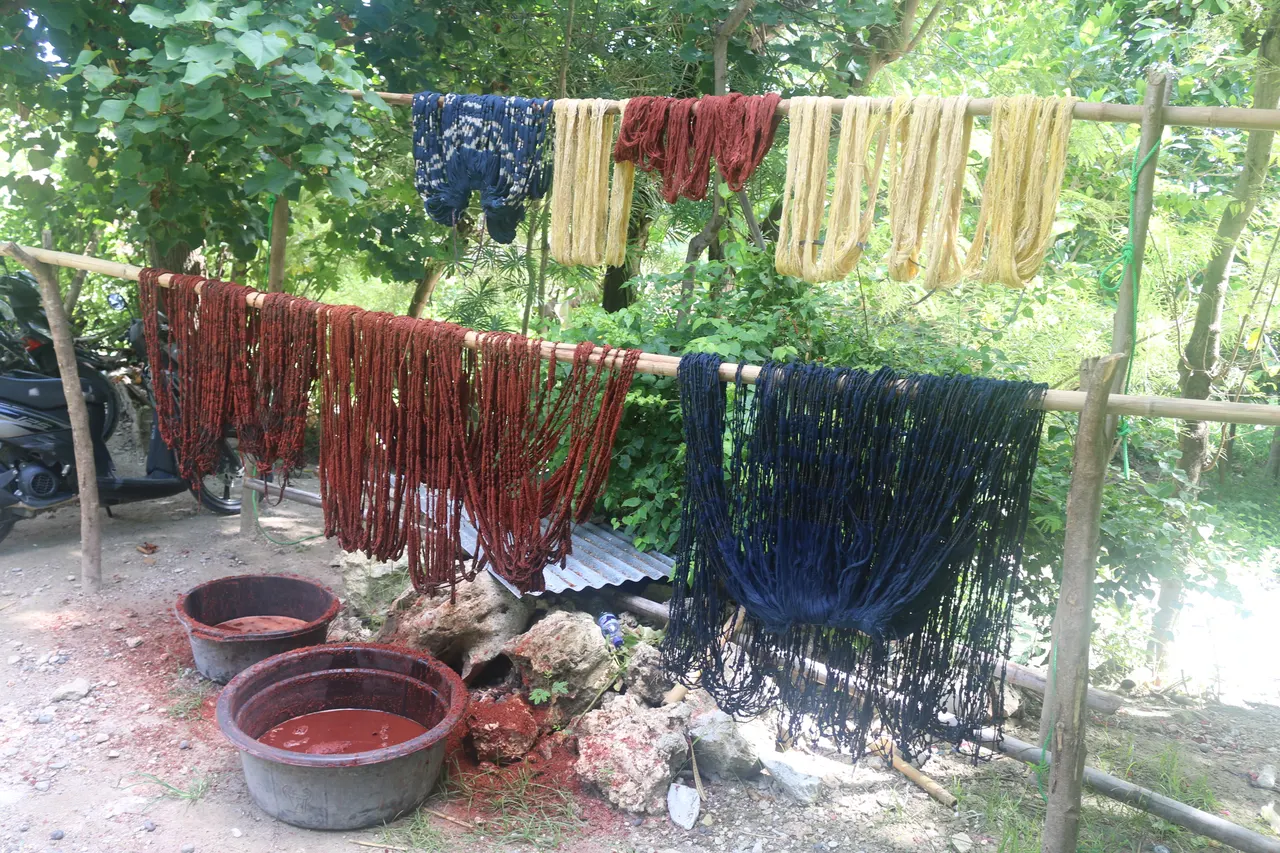
Sumba ikat is warp ikat: the pattern is tied and dyed into the threads before weaving, traditionally with indigo for blue and morinda root for red, and a large natural-dye cloth can take around 4 to 12 months. The easiest place to buy directly from weavers is Kampung Raja Prailiu on the edge of Waingapu, with the Melolo delta villages (Pau, Umabara), Rende and Kaliuda further south-east. Expect roughly Rp 250,000 for a small chemical-dye piece and from about Rp 1.5 million to well over Rp 10 million for a large hand-spun, natural-dye hinggi (2025-2026, prices vary).
- Technique
- Warp ikat (pattern tied and dyed into threads before weaving)
- Main cloths
- Hinggi (men's cloth, made in pairs), lau (women's tube skirt)
- Natural dyes
- Indigo (blue), morinda root (red), mordant from loba leaves
- Time to make
- About 1 week (simple) to 4-12 months (large natural-dye hinggi)
- Best villages
- Prailiu and Lambanapu (Waingapu), Pau, Umabara, Rende, Kaliuda
- Rough prices 2025-2026
- Rp 100,000-500,000 small; Rp 1.5-10 million+ large natural dye
In the late morning in Prailiu, on the eastern edge of Waingapu, the loudest sound is often a wooden beater knocking against a backstrap loom. Hanks of tied cotton hang drying under the eaves of high-peaked houses, some the rust colour of morinda root, some a blue so deep it reads as black. A woman sits on the floor with the loom strapped around her hips, leaning back to keep the warp tight, and a horse with a curling tail slowly appears line by line. This is Sumba ikat, one of the great textile traditions of Indonesia, and on this island it is still made for funerals and weddings, not only for visitors.
The short answer: Sumba cloth is warp ikat, meaning the design is tied and dyed into the lengthwise threads before a single pass of weaving. The best natural-dye pieces come from East Sumba, and you can buy them directly from weavers in villages from Waingapu to Melolo, Rende and Kaliuda. Buy slowly, ask questions and expect to pay for months of work.
Hinggi, lau and the other cloths of Sumba
Two words will get you through any conversation about Sumba textiles.
Low Tide, every Sunday
One short letter a week about living well, from an island with more horses than traffic lights. Free.
We only use your email to send the letter. Unsubscribe in one click.- Hinggi is the large rectangular men's cloth. It is traditionally made in pairs: one is wrapped around the hips and the other thrown over the shoulder. Noble hinggi are larger and dyed in red and indigo, and in the past only nobles could wear them, mainly at festivals.
- Lau (also written lawu) is the women's tubular skirt. Many lau are not ikat at all but plain weave decorated with supplementary warp (lau pahudu), embroidery, beads or shells (lau hada). The supplementary warp technique, called pahikung, is a separate skill from ikat.
- Tiara are narrow cloths used as shoulder cloths or headbands.
These cloths are far more than clothing. They mark status, they are exchanged as counter-gifts for the horses, buffalo and gold given as bridewealth at weddings, and they are given at funerals. At important funerals the body is wrapped in many layers of cloth and buried with them. A family's store of old cloths is also its pattern library, from which younger weavers take motifs. If you want the wider picture of the belief system behind this, read our guide to Marapu, ikat and the traditional villages.
How Sumba ikat is made, step by step
Ikat comes from the Indonesian word mengikat, to tie. The process, as described by weavers in East Sumba and by textile researchers, goes roughly like this:
- Spinning. The finest cloths start with locally grown cotton spun by hand. Many cheaper cloths use factory yarn.
- Warping. The threads are wound onto a frame whose length sets the length of the cloth. Hinggi are usually woven as two identical panels and sewn together, and the design mirrors from end to end and side to side.
- Tying. Bundles of warp threads are tightly bound with dye-resistant material (traditionally gebang palm leaf, today often plastic string) wherever the colour must not go. Older weavers held the whole design in memory; since the 1970s many designs have been drawn on gridded paper to help younger weavers learn.
- Dyeing. The tied warp goes into the dye bath. It is then untied, retied in new places and dyed again for each additional colour. Red and blue overdyed together give dark browns and near-blacks.
- Weaving. Only once the dyeing is finished are the threads set on a backstrap loom. The motif appears row by row, with the soft, slightly feathered edges that mark real ikat.
In traditional households each stage, from setting the warp to tying, dyeing and weaving, is opened with prayers to the Marapu, and before blue dyeing some families still offer a chicken. Weaving is women's work: girls start spinning young, and by their early teens many can make small pieces.
Natural dyes: indigo, morinda and the mordant
The two great colours of Sumba come from plants.
- Blue comes from indigo leaves (nila or tarum). Repeated dips build the colour from sky blue to almost black.
- Red comes from the root bark of morinda (Morinda citrifolia, known locally as mengkudu or kombu). The yarn is pounded between dye baths to drive the colour in. Morinda red was once reserved for the nobility, a rule that has largely lapsed.
- Other colours include yellow from kayu kuning wood or turmeric, brown from mangrove bark or mud, with candlenut used in the oiling of the yarn.
- The mordant that fixes the red is loba, an aluminium-rich plant (Symplocos) traditionally collected in forests above about 600 m.
Natural dyeing is slow. Dyeing and drying take the longest part of the work, and dyed yarn needs several days to dry between baths. That is why many weavers switched to synthetic dyes, and why several programmes are now training East Sumba weavers to return to natural colour.
How long does a Sumba ikat take?
Reports from weavers vary with size, technique and dye:
| Piece | Typical time |
|---|---|
| Simple cloth, factory yarn, synthetic dye | About 1 week to 1 month |
| Large hinggi, around 3 m x 1.2 m, natural dye | Around 4 to 8 months, sometimes a year or more |
| Ceremonial or heirloom-quality cloth | Many months, occasionally years |
Keep those numbers in mind when you hear a price. A large natural-dye hinggi represents months of skilled labour by several members of a family.
Motifs and what they mean
Sumbanese motifs are a bestiary. On East Sumba hinggi you will see:
- Horses (njara): wealth, prestige and the island's identity. Horses are also bridewealth.
- Roosters and chickens (manu): linked to ritual sacrifice and found on royal cloths.
- Shrimp and lobsters (kurangu): rebirth, because shrimp shed their shells, and by extension the powers of a ruler.
- Deer with spreading antlers, crocodiles, snakes, turtles, cockatoos and geckos.
- The skull tree (andung), a memory of the headhunting past, and human figures that often stand for ancestors.
- Mamuli, the gold ornament given as bridewealth, a symbol of fertility and rank.
- Foreign borrowings such as the lions of the Dutch coat of arms and Chinese dragons, which entered the repertoire in the colonial era.
Wearing a creature is believed to lend its qualities to the wearer. But meanings differ from village to village and family to family, so the best source is the weaver herself. Ask her what the figures on her cloth mean; it is the most rewarding question you can ask in Sumba.
East Sumba vs West Sumba styles
East Sumba (around Waingapu, Kambera, Melolo, Rende and Kaliuda) is the home of the famous large figurative hinggi in indigo and morinda, the style most collectors mean when they say "Sumba ikat". Kambera is both the district that surrounds Waingapu (Prailiu and Lambanapu lie in it) and the name of a regional style known for roosters and lions.
West and Southwest Sumba (Waikabubak, Kodi, Wewewa) weave too, but textiles there more often use geometric patterns, stripes and darker tones, and much of the cloth is made with factory-dyed yarn. Simpler pieces can be quicker and cheaper. You can see weaving in West Sumba villages such as Prai Ijing near Waikabubak.
Where to buy: weaving villages in East Sumba
All distances are from central Waingapu by road; times are approximate and depend on traffic and road works. See our guide to getting around Sumba for drivers and motorbikes.
Kampung Raja Prailiu (2 km, about 10 minutes)
The royal village of Prailiu sits at the eastern end of town, roughly halfway between the airport and the centre, on Jalan R. Suprapto. Most residents weave, you can watch every step from tying to weaving, and the selling is relaxed. Expect to sit, chat, sign the visitors' book and leave a contribution. It is the easiest place for a first visit.
Lambanapu (about 6 km, 15 minutes)
Lambanapu, just south of town in Kambera district, is associated with natural-dye weaving. It is less set up for visitors than Prailiu, so going with a local guide or driver who knows the families helps.
Pau and Umabara, Melolo delta (about 60-65 km, roughly 1-1.5 hours)
Two villages about 4 km from Melolo town in the river delta. Thread bundles dry in the yards and dye plants grow nearby. Women bring out their cloths when you arrive, and some younger weavers speak basic English and will explain the symbols. Umabara has ornately carved royal tombs; Pau is known for intricate work. Melolo itself has a weavers' cooperative gallery.
Rende (Praiyawang), about 70 km, roughly 1.5 hours
Seven kilometres south of Melolo, the old royal compound of Rende has some of the largest stone tombs on the island, and women here weave cloth for ceremonies, not only for tourists. Nearby Rindi is acclaimed for its hinggi.
Kaliuda (about 105 km, roughly 1.5-2 hours)
On the south-east coast in Pahunga Lodu district, Kaliuda is one of the most important ikat-producing areas, famous for horse-and-rider motifs in blue and white. Looms are often set up in front of the houses. It is best for serious textile lovers who can give it a day.
Building a trip around weaving? Our 5, 7 and 10-day Sumba itineraries include an East Sumba loop.
How to tell hand-woven natural-dye ikat from machine-made or chemical
- Is it woven or printed? In real ikat the pattern is in the threads, so it looks the same on both sides. Printed "ikat-style" fabric is sharp on the front and pale on the back.
- Look at the edges of the motifs. Hand-tied ikat has slightly blurred, feathered outlines and small irregularities. Perfectly crisp, identical repeats suggest a machine.
- Colour. Natural indigo and morinda give softer, earthier tones: rust, brick, deep navy, brown-black. Neon pinks, bright purples and very even, saturated colours usually mean synthetic dye.
- Weight and smell. East Sumba weavers say natural-dye cloth is heavier than synthetic-dyed cloth made from the same yarn, and has a faint plant smell that grows stronger in storage.
- Yarn. Hand-spun cotton is thicker and slightly uneven; factory yarn is thin and uniform. Natural dye takes poorly on factory yarn, so the two usually go together.
- Ask. Who made it, how long it took, which plants were used and whether the cotton was hand-spun. A weaver will answer with detail; a reseller often cannot.
Prices in 2025-2026 (rough ranges)
There are no fixed prices, and they vary with size, age, yarn, dye, complexity and where you buy. As a rough guide from recent reports (about Rp 100,000 = EUR 5 / USD 6):
| Type | Rough price |
|---|---|
| Small souvenir pieces, scarves, factory yarn | Around Rp 100,000-500,000 (EUR 5-27) |
| Medium pieces, simpler sarongs | Around Rp 500,000-1,500,000 (EUR 27-80) |
| Large hand-woven ikat | Around Rp 1,500,000-5,000,000+ (EUR 80-270+) |
| Large hand-spun natural-dye hinggi, ceremonial quality | Several million to Rp 10 million or more (EUR 150-530+) |
Exceptional display pieces in Waingapu galleries have been offered for around Rp 30 million. Prices can multiply as cloth passes through middlemen, which is one more reason to buy at the source. For a full trip budget see how much a trip to Sumba costs.
How to buy fairly and respectfully
- Buy from the weaver or a village cooperative where you can. More of the money stays with the maker.
- Bring cash in small and large notes. ATMs exist in Waingapu and Waikabubak, not in villages.
- Bargain gently or not at all. Hard bargaining for handicrafts can offend. If a price seems high, remember the months of work, and if it seems very low for a "natural-dye" piece, be cautious.
- Visiting is not buying. You are welcome to look without purchasing, but sign the visitors' book and leave a small contribution, and consider a small gift of betel nut (sirih pinang) when you arrive.
- Ask before photographing weavers or touching cloths, and never touch graves or ritual objects. Villages are homes, not museums.
- Workshops where you try tying or weaving usually need to be arranged in advance through a guide.
- Old cloths: heirloom textiles may have ritual value to a family. Do not pressure anyone to sell one.
Frequently asked questions
What is the difference between hinggi and lau?
Hinggi is the large rectangular men's cloth, usually made in pairs (one for the hips, one for the shoulder). Lau is the women's tubular skirt, often decorated with supplementary warp, beads or shells rather than ikat.
Where is the best place to buy ikat in Sumba?
Directly from weavers in East Sumba: Kampung Raja Prailiu in Waingapu is the easiest, while Pau and Umabara near Melolo, Rende and Kaliuda offer more serious natural-dye work about 1-2 hours' drive away.
How much does a Sumba ikat cost?
Roughly Rp 100,000-500,000 for small souvenir pieces and from about Rp 1.5 million to over Rp 10 million for a large hand-spun, natural-dye hinggi (2025-2026). Prices vary with size, dye and complexity.
How can I tell if Sumba ikat is natural dye?
Natural indigo and morinda give soft, earthy rust, brick and navy tones, the cloth feels heavier and has a faint plant smell, and it is usually woven on thicker hand-spun cotton. Very bright, even colours suggest synthetic dye. Always ask the weaver.
How long does it take to weave a Sumba ikat?
A simple cloth with factory yarn can take a week to a month; a large natural-dye hinggi of around 3 m x 1.2 m typically takes 4-8 months and sometimes a year or more.
Can I visit weaving villages without buying?
Yes. Sign the visitors' book, leave a small contribution, ask before taking photos and do not touch graves or ritual objects. Buying is welcome but never obligatory.
Places in this guide
- Kampung Raja Prailiu · Waingapu, East Sumba · Open in maps
- Lambanapu · Kambera, East Sumba · Open in maps
- Pau (Melolo delta) · Umalulu, East Sumba · Open in maps
- Praiyawang (Rende) · Rindi, East Sumba · Open in maps
- Kaliuda · Pahunga Lodu, East Sumba · Open in maps
- Fallen leaves, living colour: Threads of Life in Sumba, Kay Lawrence, Garland Magazine, 1 Aug 2026
- Sumba Ikat: Traditional Weaving, Meaning and Buying Tips, Backindo, 6 Jul 2026
- Textiles of Sumba, Wikipedia
- The popularity of Sumba textiles, Kompas, 19 Mar 2021
- Sumba memikat dengan tenun ikat, Antara, 12 Jul 2017
- Potret hidup masyarakat adat pada tenun ikat Sumba, Good News From Indonesia, 27 Nov 2025
- Prailiu village, Travelfish (Sally Arnold)
- Umabarra and Pau villages, Melolo, Travelfish (Sally Arnold)
Spotted an error? Write to info@ecobeachcity.com.
Low Tide, every Sunday
One short letter a week about living well, from an island with more horses than traffic lights. Free.
We only use your email to send the letter. Unsubscribe in one click.