Guide · Travel
Markets in Sumba: the main town markets and what to buy
Betel nut, dried fish, chillies and ikat: where to find Sumba's markets, what they sell, and why you should ask locally about market days.
The markets travellers can rely on in Sumba are the permanent town markets: Pasar Inpres in Matawai, Waingapu, the largest in East Sumba, and Pasar Waikabubak (Pasar Baru) in West Sumba, both best in the morning. Village markets exist too, notably around Kodi, where much woven cloth is sold, but no reliable list of weekly market days is published, so ask your driver or host which market is on during your stay.
- Main market in the east
- Pasar Inpres, Matawai, Waingapu: daily, best in the morning
- Main market in the west
- Pasar Waikabubak (Pasar Baru), Waikabubak: permanent town market, best in the morning
- Village markets
- Documented around Kodi (Pasar Kodi Utara, Pasar Banda Kodi); days not published
- Weekly market days
- No reliable published list; ask your driver or host
- What to buy
- Sirih pinang for village visits, fruit, snacks, ikat, honey
- Payment
- Cash in small notes; ATMs only in the main towns
The market wakes before the town. By first light, women have spread tarpaulins on the ground and stacked them with bundles of water spinach, red chillies, shallots and cassava leaves; men unload sacks of rice from a pick-up; a row of baskets holds green areca nuts and the long catkins of betel pepper, the sirih pinang that every Sumbanese household offers to guests. Dried fish hangs in the sun, chickens complain from bamboo cages, and somewhere a seller unfolds an ikat cloth for a customer who is in no hurry at all. A morning at a Sumba market is one of the easiest, most honest ways to see the island's daily life.
The short answer: the main markets travellers can count on are the permanent town markets: Pasar Inpres in the Matawai area of Waingapu, the largest market in East Sumba, and Pasar Waikabubak (often called Pasar Baru) in West Sumba. Village markets also exist, notably in the Kodi area of the south-west, where cloth is sold alongside food, but we could not find any reliable, published list of fixed weekly market days for Sumba's towns and villages. Market days vary and change, so ask your driver or host which market is on during your stay, and go early in the morning.
Why you will not find a timetable of market days
In many parts of Indonesia, rural markets follow a weekly rhythm, with villagers walking or riding in from the hills on a set day. Sumba has village markets too, but their days are passed on by word of mouth, not published. We checked tourism guides, regency websites, Indonesian media and academic studies, and none gave market days we could verify. Rather than repeat unconfirmed lists, this guide sticks to what is documented. The practical advice is simple: once you arrive, ask. Drivers, guesthouse owners and village guides always know which market is busy on which day.
Sumba this week, every Sunday
The week's news, one place worth the trip and practical travel notes. Free, and you get our 7-day Sumba guide (PDF) on signing up.
One email a week. No spam. Unsubscribe in one click. Sumba this weekWaingapu: Pasar Inpres Matawai
Pasar Inpres, in the Matawai area of Waingapu, is the main market of East Sumba and, according to a 2025 study by researchers at the local Wira Wacana Christian University (Unkriswina), one of the largest in the regency. Women traders sell vegetables there every day: mustard greens, spinach, water spinach, cassava leaves, shallots, garlic, bird's-eye chillies, tomatoes, carrots, cabbage and lettuce. Travel guides add fish, herbs, spices and betel nut, and sometimes woven textiles or ceremonial items.
- When to go: in the morning, when the produce is fresh and the market is at its busiest.
- What to look for: sirih pinang to take as a gift to villages, local fruit, and the snacks and dried goods sold around the edges.
- Nearby: the king's village of Prailiu, a short drive from the centre, where weavers sell ikat directly. Our guide to where to buy ikat in Sumba covers it in detail.
Waikabubak: Pasar Baru and the town-centre stalls
In Waikabubak, the capital of West Sumba, Pasar Waikabubak, often called Pasar Baru, is a working market rather than a tourist attraction: produce, dried fish, live chickens, betel nut, household goods and sometimes local cloth. Go in the morning. CNN Indonesia, visiting in 2016, also described stalls at Pasar Wai Liang, near the town's main field, selling bracelets, necklaces, woven cloth, regional clothing and honey, with cloth priced at the time from about IDR 250,000 up to IDR 10 million and honey from about IDR 60,000 to 100,000 a bottle. Prices will have changed, but the range shows the gap between everyday cloth and fine, naturally dyed pieces.
Waikabubak is a good base for markets because the traditional villages of Tarung and Praijing are within walking or short driving distance. Travellers have long noted that when visitors arrive in a village, an impromptu market often appears, with women bringing out cloth to sell. You are never obliged to buy, but a polite look is always welcome.
Kodi and the village markets of the south-west
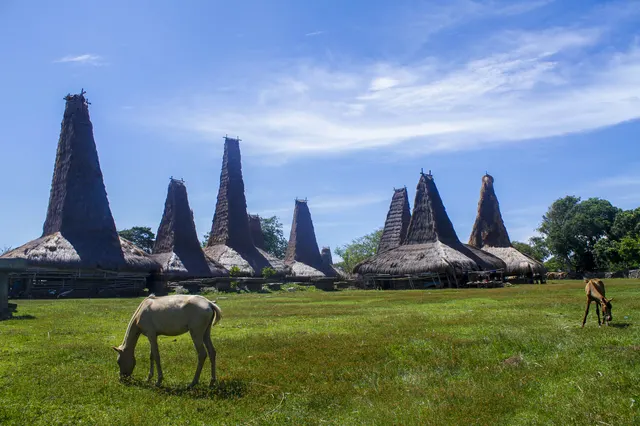
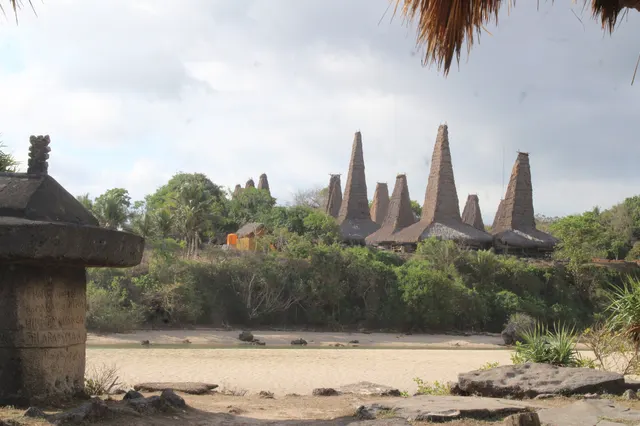
The Kodi area of Southwest Sumba, famous for its tall-roofed villages and for the Pasola, has its own markets. A 2019 study of food exchange in West and Southwest Sumba by researchers from Gadjah Mada University mentions Pasar Kodi Utara, where the authors bought wild yams (gembili) for a shared meal, and Pasar Banda Kodi, where one weaver sold her cloth in the afternoons and used the money to buy rice from traders from Bima and Sabu. The researchers noted that the markets in Kodi offer a great deal of woven cloth.
These are local markets that serve local needs, not tourist sights, and their days and hours are not published. If you are staying near Kodi or visiting Ratenggaro, Wainyapu or Pero, ask your guide whether a market is on that day.
What you will find at a Sumba market
- Sirih pinang: betel leaf or catkins and areca nut, chewed with lime. Offering it is the classic courtesy when you enter a village, alongside your donation. A small bag costs a few tens of thousands of rupiah.
- Vegetables, herbs and spices: leafy greens, chillies, shallots, garlic, tomatoes and cassava leaves, mostly sold by women traders.
- Fish: fresh in the coastal towns, and dried or salted fish everywhere.
- Live animals: chickens are common; larger animals change hands through other channels, often linked to ceremonies.
- Rice and staples: rice, corn and tubers, much of it brought in by traders from other islands.
- Textiles and crafts: ikat cloth, scarves and sarongs, beaded jewellery, baskets and sometimes carved wood and knives.
- Honey: local and Sumbawa honey appear at Waikabubak stalls.
- Snacks: look for traditional Sumbanese snacks such as manggulu and kaparrak, which have become rare; markets and food-souvenir shops are where they still turn up. Our guide to Sumbanese food explains what to try.
Prices, bargaining and paying
Produce prices at Sumba markets are usually fair and more or less fixed, so there is no need to haggle over a bunch of greens. Textiles are different: prices depend on the dye (natural or synthetic), the thread (hand-spun or factory), the size and the time a piece took to weave, which can be months. Bargain gently and with a smile, and remember that the woman in front of you may have made the cloth herself.
- Cash only. Carry small notes (IDR 2,000, 5,000, 10,000 and 20,000). ATMs are found only in the main towns, Waingapu, Waikabubak and Tambolaka.
- Rough 2025-2026 guide: a simple warung plate of rice with chicken or fish costs around IDR 20,000-50,000 (about USD 1-3). Our guide to Sumba travel costs has more prices.
- Bring a bag. Sumba has limited recycling, and a reusable bag saves a pile of plastic.
Market etiquette
- Ask before you photograph stallholders, especially older women and children. A smile and a gesture with the camera is enough; accept a no.
- Buy something if you spend time at a stall, even if it is only a little fruit or a bag of sirih pinang.
- Dress modestly, with shoulders and knees covered, as you would in a village.
- Watch your step: floors are uneven and often wet, and the busiest lanes are narrow.
- Keep valuables close. Sumba is not a pickpocket hotspot, but crowded markets are where ordinary care pays off.
- Do not touch ritual objects or ceremonial items you do not understand; ask what they are for.
A few words for the market
Few stallholders speak English, and a handful of Indonesian words go a long way. Sumbanese languages differ from area to area, but Indonesian is understood everywhere.
- Berapa? How much?
- Terima kasih: thank you.
- Boleh foto? May I take a photo?
- Mahal / murah: expensive / cheap. Use with a smile, and only for textiles and crafts.
- Satu kilo, setengah kilo: one kilo, half a kilo.
- Tidak pakai plastik: no plastic bag, thanks.
Our Sumba phrasebook has more useful words, including greetings in local languages.
How to fit a market into your trip
The easiest plan is to start a travel day with a market. Leave Waingapu after an early walk through Pasar Inpres and head for the savanna of Wairinding or the mangroves of Walakiri; or begin in Waikabubak at Pasar Baru, buy sirih pinang and fruit, and then visit Tarung and Praijing, or drive south to the Pasola country of Wanokaka. In the rainy season, markets are also a good rainy-morning plan, since they are covered or close to shelter. If you plan to visit villages afterwards, read our guide to Marapu, ikat and traditional villages first, and see getting around Sumba for driving times between towns.
Frequently asked questions
What is the biggest market in Sumba?
In East Sumba it is Pasar Inpres in the Matawai area of Waingapu, described by a 2025 university study as one of the largest markets in the regency. In West Sumba the main market is Pasar Waikabubak, often called Pasar Baru.
Which days are market days in Sumba?
Pasar Inpres in Waingapu trades every day and Pasar Waikabubak is a permanent town market; both are busiest in the morning. Village markets have their own days, but we found no reliable published list, and days can change, so ask your driver, guesthouse or village guide when you arrive.
What should I buy at a Sumba market before visiting a village?
A small bag of sirih pinang (betel and areca nut) is the traditional gift when you enter a village, alongside the donation in the guest book. It costs a few tens of thousands of rupiah.
Can I buy ikat at Sumba's markets?
Yes. Cloth appears at Waingapu and Waikabubak markets and is plentiful at markets in the Kodi area. For fine, naturally dyed pieces it is often better to buy directly from weavers in villages such as Prailiu, where you can see how the cloth is made.
Do Sumba markets accept cards?
No. Markets are cash only, so bring small notes. ATMs are only in the main towns: Waingapu, Waikabubak and Tambolaka.
Is it OK to take photos at Sumba markets?
Ask first, especially when photographing older women and children, and accept a refusal. Buying something small at the stall is a good way to say thank you.
Places in this guide
- Pasar Inpres Waingapu · Waingapu, East Sumba · Open in maps
- Pasar Waikabubak · Waikabubak, West Sumba · Open in maps
- Kampung Raja Prailiu · Waingapu, East Sumba · Open in maps
- Tarung village · Waikabubak, West Sumba · Open in maps
- Praijing village · Waikabubak, West Sumba · Open in maps
- Kodi (district centre, near Bondo Kodi) · Southwest Sumba · Open in maps
- Kontribusi wanita pedagang sayuran terhadap pendapatan keluarga: studi kasus Pasar Inpres Matawai, Waingapu, Unkriswina (SATI 2025)
- Reproduksi moda (pertukaran) pangan: menyemai daulat hidup di Sumba Barat (Daya), Laksono et al., Jurnal Masyarakat & Budaya, 2019
- Waikabubak, Sumba: what to see, where to stay and travel tips, Backindo, 6 Aug 2025 (updated Jul 2026)
- Waingapu, Sumba: what to do, where to stay and travel tips, Backindo, 27 Aug 2025 (updated Jul 2026)
- Wisata satu malam di Sumba Barat, CNN Indonesia, 27 Nov 2016
- Travelling and shopping in Sumba, Tripadvisor Sumba forum, accessed Nov 2026
Spotted an error? Write to info@ecobeachcity.com.
Sumba this week, every Sunday
The week's news, one place worth the trip and practical travel notes. Free, and you get our 7-day Sumba guide (PDF) on signing up.
One email a week. No spam. Unsubscribe in one click. Sumba this week