Travel
Kerewe Beach, Sumba: surf, karst islets and quiet bays in Lamboya
A long right-hand wave, rock islets at the western end and hidden coves over the hill: what Kerewe (Kerewei) is like, how to reach it and what to know.
Kerewe (also spelled Kerewei or Kerewee) is a beach in Lamboya, West Sumba, near Marosi on the island's south-west coast, known for a long right-hand reef wave and limestone islets at its western end. It is roughly 70 km from Tambolaka, about 1.5-2 hours by car, with the last stretch on unpaved roads. Surfers come in the dry season (roughly April-October) at mid tide; the wave is for intermediate and advanced surfers, not beginners.
- Where
- Lamboya, near Patiala Bawa and Marosi, West Sumba
- From the nearest airport
- Tambolaka (TMC): roughly 70 km, about 1.5-2 hours by car (last stretch unpaved)
- Best time
- Dry season (roughly April/May-September/October); mid tide and early morning for surf
- Entry
- No entry fee reported; small cash for parking or contributions
- Good for
- Surfing (intermediate-advanced), quiet beach days, rock islets, sunset viewpoints
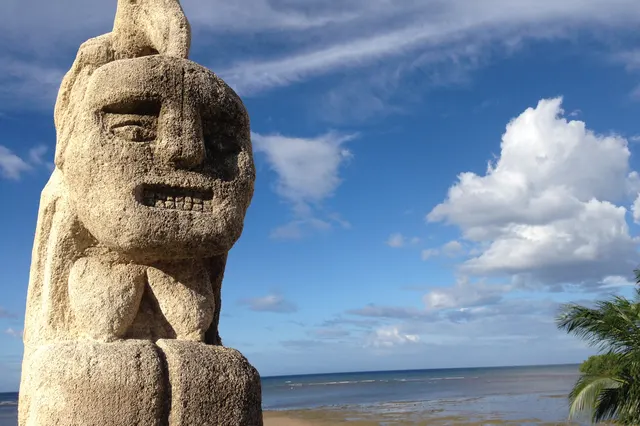
The dirt road drops through coconut palms and stops at the sand. To the west, a cluster of grey limestone islets stands in clear water over a small reef; to the east, the beach curves away in a long, pale arc. Out on the point a right-hander peels for what seems like forever, and the only sounds are the waves, the wind in the palms and, now and then, a scooter carrying seaweed back from the drying racks.
Kerewe is one of the quieter beaches on the Lamboya coast of West Sumba, popular with surfers and with travellers looking for simple homestays and empty sand. Here is what to know.
What Kerewe Beach is and why go
Kerewe lies in the Lamboya area of West Sumba (Sumba Barat regency), near the village of Patiala Bawa and close to Marosi beach, about an hour's walk away. The sand is pale, slightly greyer than nearby beaches, although some locals call it black sand. At the west end a group of dramatic karst islets rises from the water; the largest is popular for scrambling and gives views over clear water and a small reef. Walk west and up the grassy hill for a viewpoint over small hidden bays. Expect seaweed drying racks, a football pitch under the palms and a small kiosk selling drinks and fuel.
Low Tide, every Sunday
One short letter a week about living well, from an island with more horses than traffic lights. Free.
We only use your email to send the letter. Unsubscribe in one click.The surf: Kerewe is best known for a right-hand reef break running roughly 500 m. It works on south-east to south-west swells from about 2 feet, best at mid tide and with winds from the north; low tide exposes shallow reef. Surf guides rate it for intermediate and advanced surfers and warn that Sumba's waves are thick and powerful. See our guide to surfing in Sumba.
How to get to Kerewe Beach
Kerewe is in the south-west of West Sumba, roughly 70 km from Tambolaka, similar to neighbouring Marosi. Allow about 1.5-2 hours by car. The final kilometres are on dirt roads and a sandy track, manageable by motorbike or car in the dry season.
- From Tambolaka (TMC): car with driver, around IDR 1,000,000-1,500,000 (about EUR 50-75 / USD 60-90) per day in 2025-2026; prices vary.
- From Waikabubak: the capital of West Sumba is the nearest town with ATMs and shops; head south towards Lamboya and ask for directions locally.
- Local transport: ojek (motorbike taxis) operate from Wanokaka and Lamboya; one traveller paid around IDR 50,000 for an ojek from Wanokaka to Marosi (prices from 2017, likely higher now).
- From Waingapu (WGP): roughly 4-5 hours by road to Waikabubak, then south to the coast.
When to go and best time of day
The dry season, roughly May to September, has dry roads and the most reliable south-west swells; some surf guides suggest the early season from around March to June for waves east of Bali. For surfing, aim for mid tide and early morning, before the wind picks up. In February the Lamboya Pasola is usually held in this area, with dates set by the elders (see Pasola explained). Late afternoon on the hill above the western bays is lovely for sunset.
Tips and etiquette
- Fees: no entry fee is reported for the beach itself. Keep small cash for parking or village contributions.
- Surf safety: shallow reef at low tide, a long paddle back if you ride the wave through, and powerful sets. Not a spot for beginners. Reef booties help.
- Swimming: only in calm conditions inside the reef; there are no lifeguards.
- Access and land: parts of this coast are being bought and fenced, and access may change. Use public paths and respect private land.
- Taboo places: ask your driver or host about pemali (taboo) areas before exploring further along the coast.
- Rubbish: travellers have noted litter here. Take yours away and consider picking up a little more.
- Connectivity: mobile coverage is reported to be surprisingly good, but bring cash: the nearest ATMs are in Waikabubak.
Nearby
- Marosi Beach: the neighbouring beach, with reef breaks and wide sand.
- Watu Maladong Beach: limestone rock islands further west along the south coast.
- Waikabubak: West Sumba's capital, with traditional villages in town.
- Lapopu waterfall: tiered falls in Wanokaka, inland to the east.
Frequently asked questions
Is Kerewe the same as Kerewei?
Yes. Kerewe, Kerewei and Kerewee are spellings of the same beach in Lamboya, West Sumba.
Is Kerewe good for beginner surfers?
No. The right-hand reef wave suits intermediate and advanced surfers; low tide exposes shallow reef and the waves are powerful.
How far is Kerewe Beach from Tambolaka airport?
Roughly 70 km, about 1.5-2 hours by car, with the last section on dirt roads.
Is there an entrance fee at Kerewe Beach?
No entry fee has been reported for the beach itself. Carry small cash for parking or local contributions.
Places in this guide
- Kerewe Beach (Patiala Bawa village area, Lamboya) · West Sumba · Open in maps
- Kerewee Beach (Climb the hill for great rewards), Travelfish
- Kerewei Right surf guide, Mondo Surf
- Sumba surf region, Indo Surf
- Pantai Kerewei, TravelPal
- Sumba: Wanokaka and Lemboya, The Spice Route End
- Patiala Bawa, OpenStreetMap (Nominatim)
Spotted an error? Write to info@ecobeachcity.com.
Low Tide, every Sunday
One short letter a week about living well, from an island with more horses than traffic lights. Free.
We only use your email to send the letter. Unsubscribe in one click.